

The BH4 ShuntThe central mechanism of the Cascade
The proposed mechanism through which redox conditions reallocate biological resources across BH4-dependent pathways, connecting a prioritized stress response to autism traits and biochemically linked comorbidities.
This page focuses on the BH4 Shunt itself. The full Cascade follows it outward through pathways, physiology and trait clusters.
The BH4 Shunt at the center
The diagram shows how chronic allostasis leads to the GCH1 redox-regulated BH4 Shunt, which branches through the AAAH, NOS and AGMO shunts into downstream autism and comorbid traits.
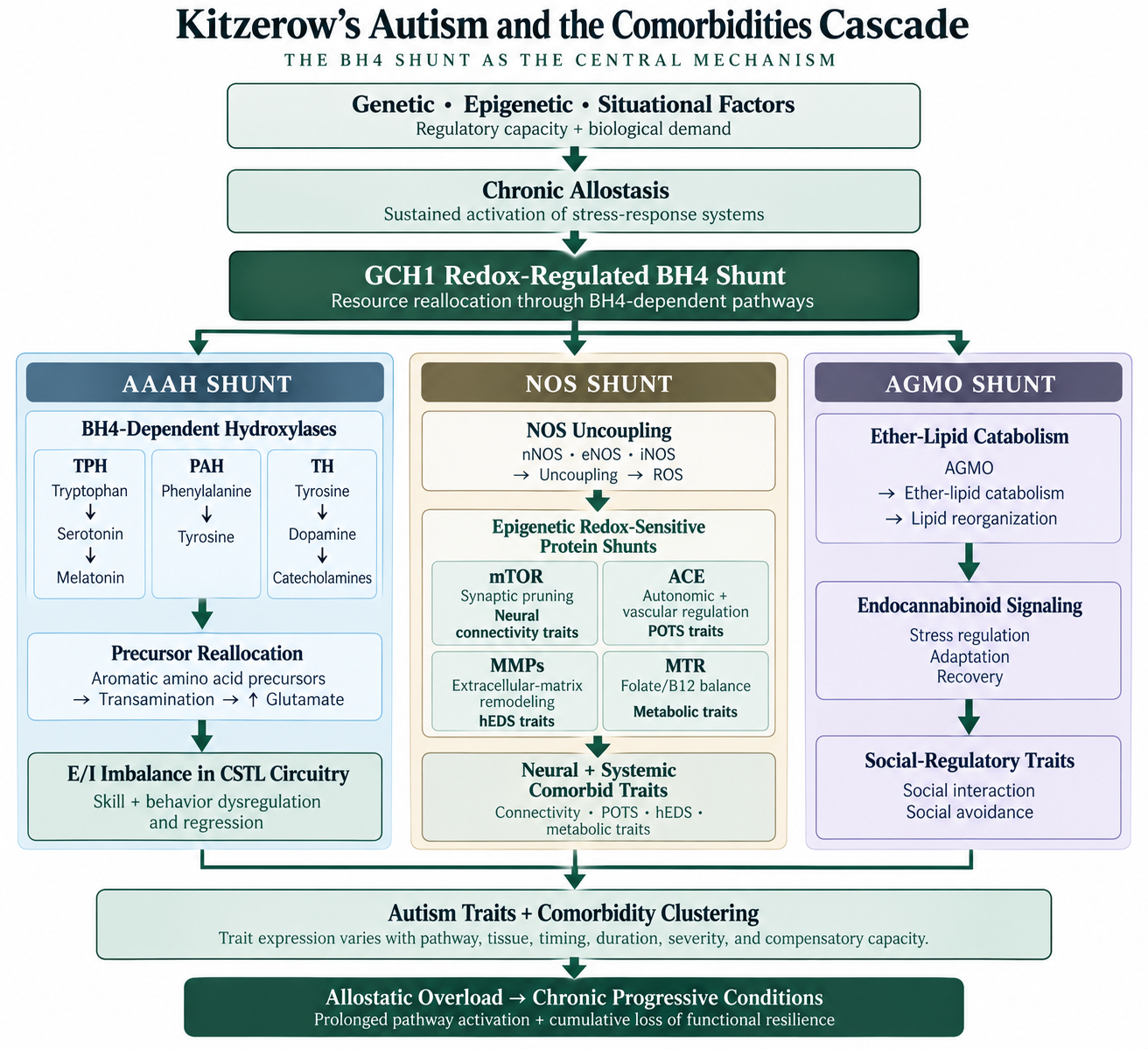
A redox-regulated allocation mechanism
Tetrahydrobiopterin, or BH4, is a redox-sensitive cofactor that several enzyme systems depend on. As BH4 oxidizes to dihydrobiopterin (BH2), the changing BH4-to-BH2 balance alters pathway function. The BH4 Shunt proposes that resources are reallocated through these BH4-dependent pathways under redox conditions.
Regulatory and redox demand
Immune, metabolic, repair, nervous-system and gene-regulatory demands change redox conditions and resource priorities.
BH4-to-BH2 redox regulation
Redox-sensitive BH4 oxidation and altered BH4-dependent enzyme activity regulate how resources move through competing pathways.
Pathways, traits and comorbidities
Reallocation extends across neurotransmission, nitric-oxide signaling, oxidative balance, lipid biology, repair and physiology.
BH4 biology
- The aromatic amino-acid hydroxylases, nitric-oxide synthases and AGMO all depend on BH4.
- BH4 oxidation can uncouple NOS toward superoxide production.
- E/I imbalance and altered corticostriatal function have long been investigated in autism.
One coordinated mechanism
- Redox conditions reallocate resources across all three branches by cellular need, as one system.
- Reduced hydroxylation sends aromatic amino-acid precursors toward transamination and glutamate synthesis, explaining E/I imbalance across CSTL circuitry.
- NOS uncoupling acts as both a regulatory effector and a source of ROS that sustains redox pressure.
Why the BH4 Shunt reinforces itselfBH4 is both affected by redox conditions and involved in producing them
When BH4 availability or the BH4-to-BH2 balance disrupts nitric-oxide synthase coupling, BH4-dependent NOS can become a source of reactive oxygen species, further influencing BH4 oxidation and resource allocation through the Shunt.
How the branches connect to autism researchE/I balance, CSTL circuitry, NOS and lipid signaling
Excitation/inhibition imbalance and altered corticostriatal function have long been investigated in autism, alongside documented differences in thalamocortical connectivity. Within the CSTL system, these differences can affect traits involving movement, habit formation, motivation and reward.
The BH4 Shunt offers a mechanistic explanation for why E/I imbalance can arise across this circuitry: redox-driven changes in BH4-dependent activity reallocate aromatic amino-acid precursors toward transamination and increase glutamate synthesis. Across the NOS branch, uncoupling acts both as a regulatory-system effector and as a source of ROS that can sustain redox pressure and influence redox-sensitive protein induction. Across the AGMO branch, changes in BH4-dependent activity alter ether-lipid and endocannabinoid metabolism, extending the Shunt’s effects into membranes, signaling, neural function and systemic physiology.
How redox regulation reallocates resources
Reallocation does not happen before the BH4 Shunt. It happens through the Shunt and its BH4-dependent pathways as redox conditions change BH4 availability, oxidation, recycling and enzyme coupling.
- Allostatic demandRegulatory activation changes biological demand and local redox conditions.
- BH4 oxidationRedox-sensitive BH4 oxidizes to BH2, changing the functional BH4-to-BH2 balance.
- The BH4 ShuntResources are reallocated through the BH4-dependent AAAH, NOS and AGMO pathways.
- NOS-derived ROSAltered NOS coupling generates reactive oxygen species and reinforces redox pressure.
- System outcomesPathway changes carry through physiology, traits and comorbidity clusters.
Function matters more than abundance alone. A measured protein level does not by itself establish pathway function. The model also weighs the BH4-to-BH2 balance, substrate access, cofactor recycling, location, interacting proteins, isoforms, modifications, enzyme coupling and metabolic flux.
AAAH, NOS and AGMO under the Shunt
BH4 is an essential cofactor across three established branches. Under redox conditions, the Shunt changes how resources move through each, and where the upstream precursors go. Open each branch for the established biology, the proposed mechanism and the trait impact.
GTP flow toward neopterin
During interferon-driven activation of human macrophages, GTP cyclohydrolase I activity can exceed downstream PTPS capacity, causing neopterin to accumulate at the expense of BH4 production in those cells.
Less BH4 for every branch
Altered upstream pterin allocation can change BH4 support for downstream neurotransmitter, nitric-oxide, redox and lipid pathways. This offers a potential explanation for the elevated urinary neopterin-to-creatinine and neopterin-to-biopterin ratios observed in autism research.
Aromatic amino-acid hydroxylases
PAH, TH and TPH connect BH4 to phenylalanine and tyrosine processing and to dopamine and serotonin synthesis.
Established biology
Under the Shunt
Reduced BH4-dependent hydroxylation reallocates aromatic amino-acid precursors toward transamination reactions that form glutamate. The resulting glutamate synthesis can perpetuate E/I imbalance in corticostriatal circuitry implicated in autism and extend across cortico-striatal-thalamo-limbic circuitry.
Trait impact
A potential mechanistic explanation for the E/I imbalance observed in autism research and for traits involving movement and repetitive motor behavior, habit formation and altered reward processing.
Nitric-oxide synthases
The BH4-to-BH2 balance helps decide whether NOS stays coupled, making nitric oxide, or shifts toward reactive oxygen species.
Established biology
- Neuronal, endothelial and inducible NOS require BH4 for coupled nitric-oxide production.
- BH4 supports electron transfer and nitric-oxide synthesis from L-arginine during coupled NOS activity.
- BH4 oxidation can uncouple NOS and shift it toward superoxide production.
- A reduced BH4-to-BH2 ratio is associated with NOS-derived superoxide under oxidative conditions.
Under the Shunt
BH4 oxidation to BH2 lowers the functional BH4-to-BH2 ratio, allowing NOS to uncouple and produce superoxide rather than nitric oxide. This can reinforce the redox conditions that drive the Shunt and influence epigenetically regulated, redox-sensitive protein shunts that act as regulatory-system effectors.
Trait impact
In the Cascade, altered pathway activation changes systemic function and development, contributing to comorbid traits. One proposed node involves redox-sensitive mTOR regulation and its effects on synaptic development and pruning. A 2026 study demonstrated that nitric oxide-mediated S-nitrosylation of TSC2 promoted TSC2 degradation and mTOR dysregulation in autism models, supporting the proposed nitric oxide, TSC2 and mTOR connection.
Alkylglycerol monooxygenase
The only known human enzyme that cleaves the ether bond in alkylglycerols, linking BH4 to ether-lipid and endocannabinoid metabolism.
Established biology
- AGMO cleaves the O-alkyl ether bond in free alkylglycerols and lyso-alkylglycerophospholipids, requiring BH4 and molecular oxygen.
- AGMO contributes to ether-lipid catabolism and membrane-lipid regulation.
- AGMO can cleave the ether-linked endocannabinoid noladin ether.
Under the Shunt
BH4-dependent AGMO cleaves specific alkyl ether lipids, including the endocannabinoid noladin ether. Within the Shunt, altered AGMO activity may change lipid profiles, membrane biology and endocannabinoid regulation, extending into inflammation, myelination and synaptic biology.
Trait impact
Experimental ether-lipid deficiency in mice produced reduced social interaction, hyperactivity, repetitive behavior and other differences relevant to autism research. Autism studies have documented differences in lipid metabolism and endocannabinoid signaling, and an autism-model study reported altered hippocampal lipid profiles alongside endocannabinoid-system effects.
When the Shunt turns on, and off
The BH4 Shunt operates within the regulatory cycle explained by BioToggle®, the system for understanding how genetic regulation drives physiological plasticity.
- ActivationA regulatory-system domain moves away from its set point, and the resulting redox environment activates the BH4 Shunt.
- Effector managementWhile the domain is active, its effectors are managed in part through the AAAH, NOS and AGMO pathways.
- ResolutionOnce set points are restored, the redox pressure resolves, BH4 stops oxidizing at the shunt-driving rate, and the Shunt deactivates.
Why the Shunt can stay onThree entry points that set how persistent activation is
Genetically locked
Inherited or de novo variants establish a persistent starting condition affecting protein production, isoforms or function.
Epigenetically stuck
Gene-regulatory states remain shifted after developmental, environmental, immune, metabolic or stress-related influences.
Situationally flipped
Illness, stress, exposure, injury, hormonal change or nutrition temporarily changes regulatory priorities.
The outcome depends on the entry point, regulatory domain, timing, location, intensity, duration, compensatory capacity and other pathways competing for the same resources. Five regulatory domains (immune, metabolism, cellular repair, nervous system and genetic regulation) interact with five temporal domains (ultradian, circadian, circannual, developmental and aging).
Predictions that can be traced and challenged
The BH4 Shunt explains why pathways shift under redox conditions and how those shifts change physiology and trait expression, creating relationships that can be measured, challenged and refined.
What should be observed
- Biomarkers cluster along connected pathway routes rather than appearing as unrelated abnormalities.
- Direction and magnitude vary by tissue, timing, demand, redox state and compensatory capacity.
- Changes across BH4-dependent branches are interpreted together, including competition and feedback.
- Traits are traceable through intermediate protein, pathway, cellular and circuit nodes.
Patterned, not uniform
Different inputs, active effectors, compensatory responses, activation histories and timing disruptions should produce different combinations and intensities of traits, rather than one uniform biochemical profile.
Independent studies that identify the same organized pathway shifts are summarized in the Converging Evidence Overview and recent tests.
What shapes individual variationInputs, effectors, compensation, activation and timing
Individualized inputs
Genetic variants, epigenetic regulation and situational conditions set different starting states and demands.
Active effectors
The domains prioritized for survival decide which effectors are induced and which BH4-dependent pathways carry the response.
Compensatory mechanisms
Mutations, constrained capacity or allostatic overload can recruit compensatory pathways that change the direction, size or location of effects.
Activation and timing
Duration and strength of activation, and which temporal domains are disrupted, shape the pattern over time.
Interpretive boundary: association is not causation, and overlap with one part of the framework does not validate every proposed route. Each node and relationship needs evidence suited to its biological level. The Cascade is still being researched, and its validation depends on continued testing and convergent evidence.
Read the model and its record
Kitzerow’s Autism and the Comorbidities Cascade
Places the BH4 Shunt within the full cascade, from regulatory activation to trait clusters.
View the full Cascade →The BH4 Pathway as an Allostatic Mechanism
Redox-regulated reallocation through BH4-dependent NOS, AAAH and AGMO pathways.
Read the paper →Autism & the Comorbidities Along the BH4 Pathway
The first analysis connecting BH4-related biochemistry with autism and recurring comorbidities.
Read the paper →BioToggle® and Kitzerow’s Autism and the Comorbidities Cascade
Connects BioToggle® to the Cascade across regulatory domains.
Read the paper →BioToggle® and BioDial Categorical Delineation
Categorizes regulatory activation, duration, load and restoration by timing.
Read the paper →BioToggle®
The system for explaining genetic regulation and physiological plasticity.
Explore BioToggle® →Tests and progress
Independent studies compared against the Cascade, and where the research stands.
See recent tests →Tracking progress →Jigsaw Puzzle Methodology
The systems analysis used to compare distributed evidence and organize relationships among nodes.
Review the methodology →Timeline and sources
The dated development record and source index for the framework.
Documented timeline →Primary source list →Concerned about a BH4-related disorder?A medical resource for primary BH4 deficiencies
BH4-related disorders are established medical conditions that require qualified clinical evaluation. For an open-access review of primary tetrahydrobiopterin deficiencies, including diagnosis and treatment considerations, see the consensus guideline in PMC.
Authorship and attributionCompilation copyright and the attribution rubric
The BH4 Shunt is protected as a compilation: the protected authorship is Kitzerow’s original selection, coordination and arrangement of scientific data into this framework, not ownership of the underlying facts or data.
Scientific and medical notice: This page presents a proposed theoretical framework for research and education. It does not diagnose autism or any medical condition, establish a universal causal pathway, or provide treatment or supplementation guidance. Clinical decisions should be made with qualified healthcare professionals using evidence appropriate to the individual.