


NeuroToggle®
The NeuroToggle® System
Teaching Strategy Meets Neural Circuit Development
Neural circuits hold memories for producing skills and behaviors. Learning changes those circuits. NeuroToggle® guides those changes through targeted teaching.
Learn the NeuroToggle® System
Start With the Educator ToolKit
The NeuroToggle® Educator ToolKit gives educators practical, ready-to-use resources for identifying skills and behaviors, selecting aligned teaching strategies, and refining instruction based on learner response.
 ToolKit
NeuroToggle® Educator ToolKit
Includes the NeuroToggle® overview flyer, decision guide, planning worksheet, skill growth profile, and behavior replacement worksheet.
 Book
Book
Neuroplasticity Principles
Introduces the neuroplasticity concepts behind learning, memory, and neural circuit development.
 Book
Book
The NeuroToggle® System
Presents the full instructional system for building, strengthening, expanding, and timing skills and behaviors.
How NeuroToggle® Develops Skills and Behaviors
A Practical Framework for Instruction
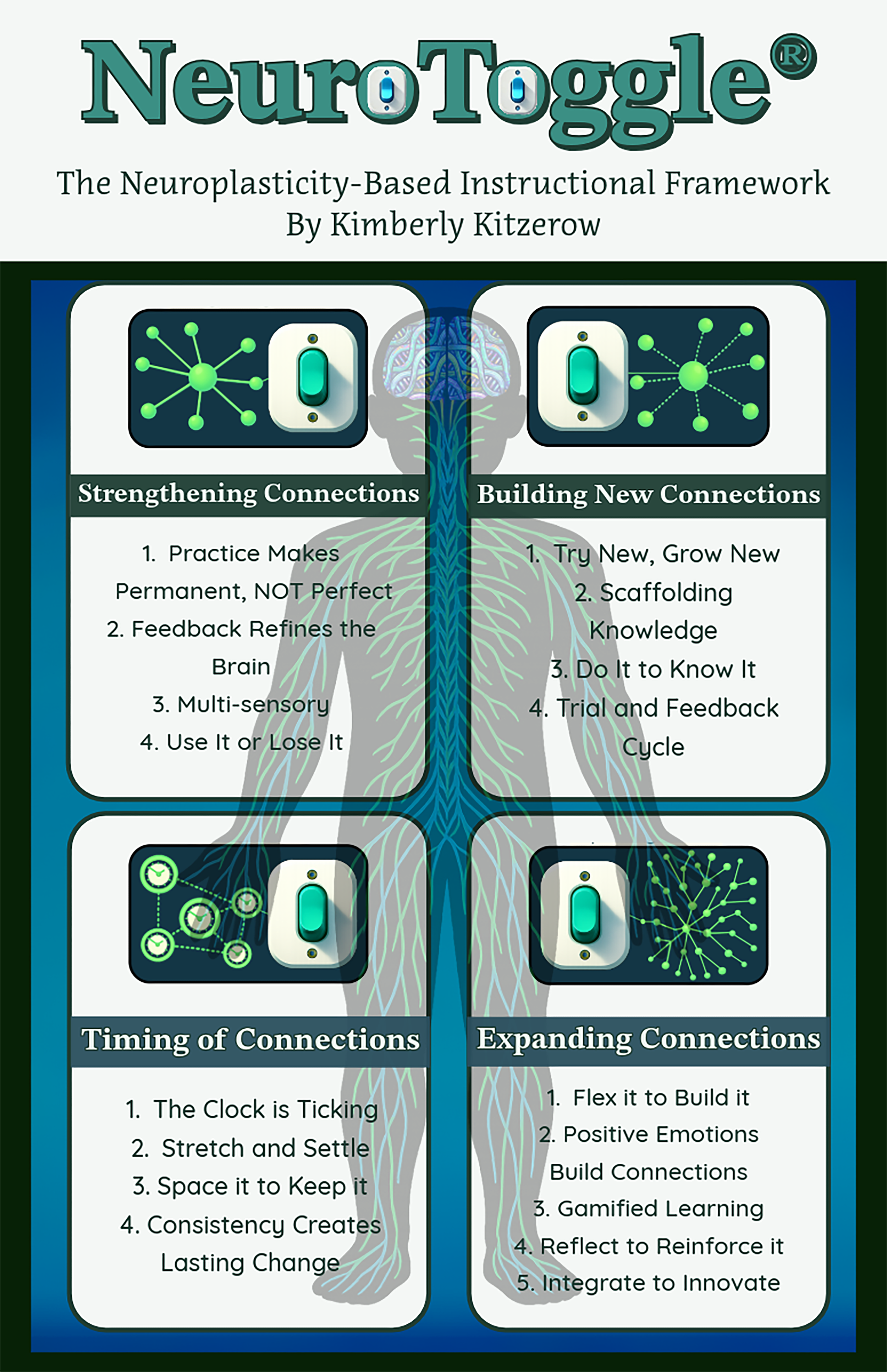
Skills and behaviors are produced through sensory, cognitive, and motor circuits working together. NeuroToggle® provides a framework for organizing teaching strategies around how those circuits develop so skills and behaviors can be built, strengthened, expanded, and timed through instruction.
Select the skill or behavior you want to develop.
Determine whether the goal is to build, strengthen, expand, or time development.
Use the NeuroToggle® teaching strategies that support that developmental goal.
Adjust instruction based on learner response and outcomes.
Develop New Skills
Try New, Grow New • Scaffolding Knowledge • Do It to Know It • Trial and Feedback Cycle
Improve Reliability
Practice Makes Permanent • Feedback Refines the Brain • Multi-Sensory • Use It or Lose It
Increase Flexibility
Flex It to Build It • Positive Emotions Build Connections • Gamified Learning • Reflect to Reinforce It • Integrate to Innovate
Optimize Learning
The Clock is Ticking • Stretch and Settle • Space It to Keep It • Consistency Creates Lasting Change
Why NeuroToggle® Is Relevant for Neurodivergent Learners
Different Neural Circuit Development Can Affect Skill Development
Neurodivergence involves differences in neural circuit development and function. Because neural circuits hold memories for producing skills and behaviors, those differences can affect how skills emerge, stabilize, generalize, and become accessible.
Sensory Circuits
Receive information from the body and environment.
Cognitive Circuits
Organize, interpret, store, and connect information.
Motor Circuits
Coordinate movement, speech, gestures, and responses.
Want to Learn More About Why Neural Circuit Development Can Become Dysregulated?
Explore BioToggle® to learn how biological systems may influence neurodivergent development, autism traits, and comorbid traits.
Speech Development and Future Research
The application of NeuroToggle® to specifically target the skill of speech remains anecdotal and warrants further investigation. Learn more about nonverbal autism, speech motor pathways, AAC, language deprivation syndrome risk, and the need for diagnostic and prognostic pathways.