Independent Replication
& Originator Erasure
Originator Erasure
I documented my discovery process through a timestamped public living documentary to establish verifiable originator evidence. As has happened throughout scientific history, institutions have begun reproducing core components of my framework without attribution.
We teach this in elementary school: if a source is not credible, it should not be used. If it is credible enough to use, the original source must be cited. That is standard academic practice.
Accessibility option: An alternative version of this content presented without expandable sections is available here.
Frequently Asked Questions
Still have questions? Take a look at the or reach out anytime at: kitzerow@kimberlyedu.org
-
I got involved in autism research after my nonverbal autistic daughter’s nonverbal autism diagnosis. It was 2020 and all in person services were shut down due to covid, so I was the only chance she had. I graduated with degrees in education and special education, and a minor in instruction strategies, from UW Superior (summa cum laude.) I went back to school for bioinformatics for help after I developed my Autism and the Comorbidities Theory in 2023. I earned all As. I was advised not to pursue a PhD at this time because any further work would be owned by my supervising professor. To maintain scientific integrity and retain ownership of my intellectual property, I have to stay independent.
-
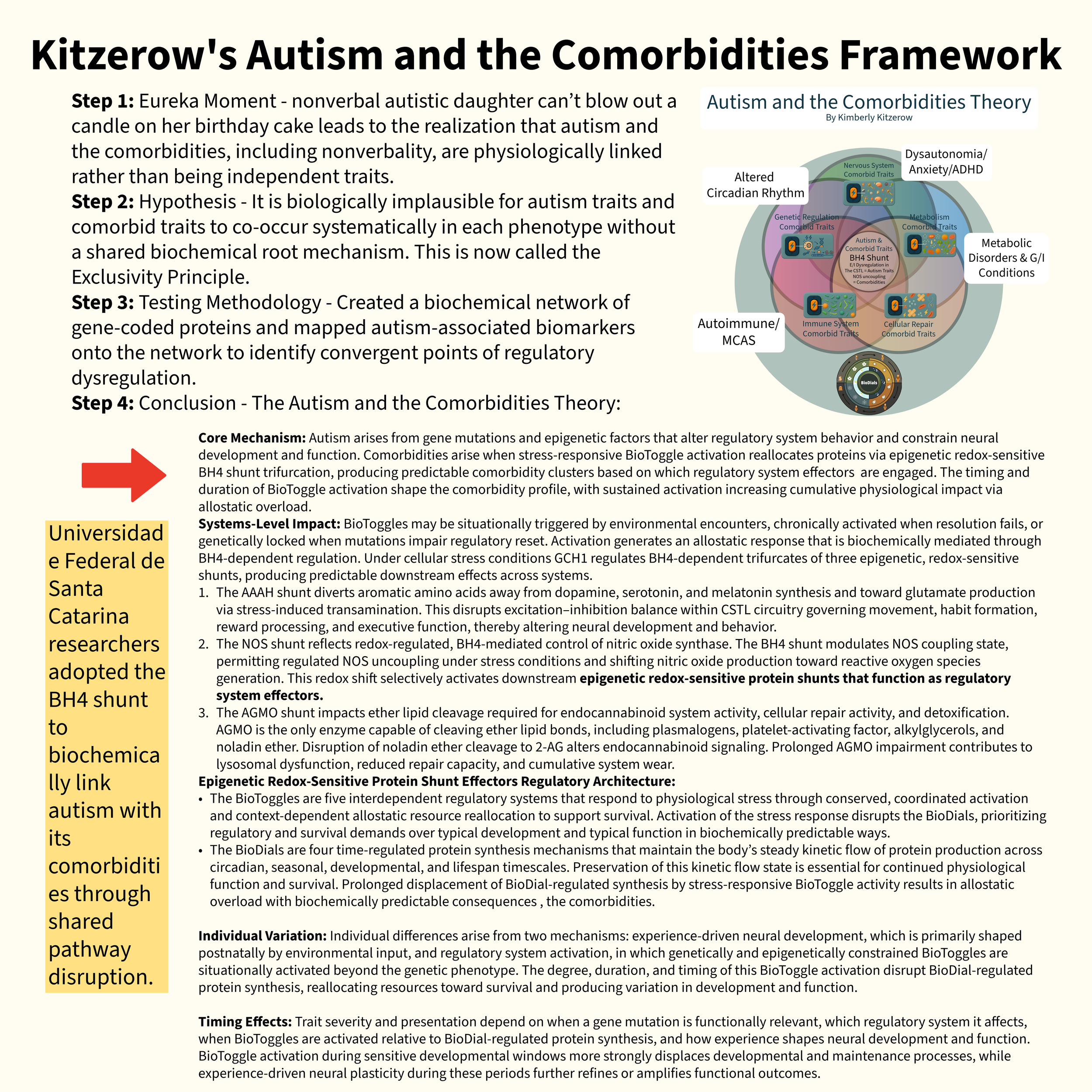
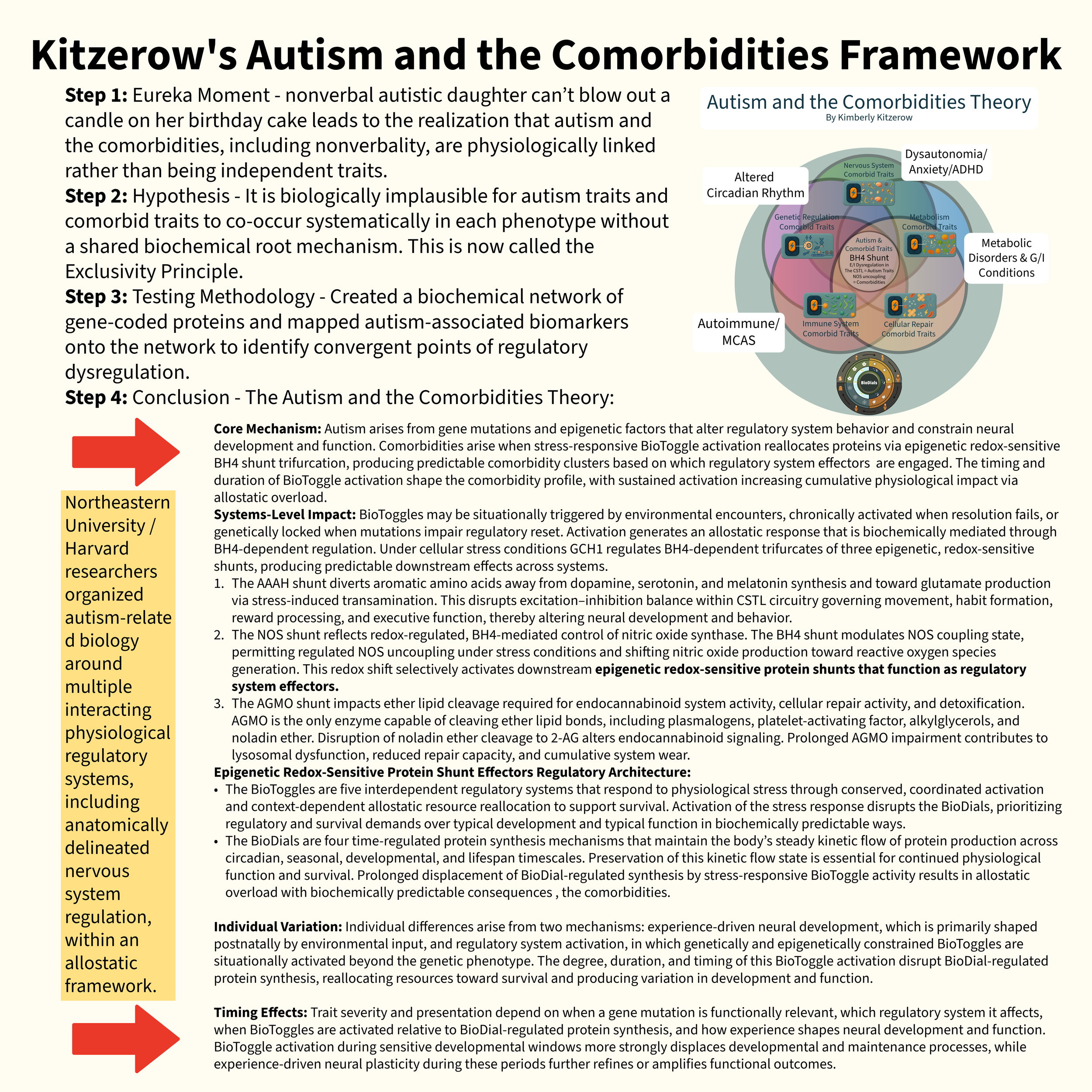
Core Mechanism: Autism arises from gene mutations and epigenetic factors that alter regulatory system behavior and constrain neural development and function. Comorbidities arise when stress-responsive BioToggle activation reallocates proteins via epigenetic redox-sensitive BH4 shunt trifurcation, producing predictable comorbidity clusters based on which regulatory system effectors are engaged. The timing and duration of BioToggle activation shape the comorbidity profile, with sustained activation increasing cumulative physiological impact via allostatic overload.
Systems-Level Impact: BioToggles may be situationally triggered by environmental encounters, chronically activated when resolution fails, or genetically locked when mutations impair regulatory reset. Activation generates an allostatic response that is biochemically mediated through BH4-dependent regulation. Under cellular stress conditions GCH1 regulates BH4-dependent trifurcates of three epigenetic, redox-sensitive shunts, producing predictable downstream effects across systems.
The AAAH shunt diverts aromatic amino acids away from dopamine, serotonin, and melatonin synthesis and toward glutamate production via stress-induced transamination. This disrupts excitation-inhibition balance within CSTL circuitry governing movement, habit formation, reward processing, and executive function, thereby altering neural development and behavior.
The NOS shunt reflects redox-regulated, BH4-mediated control of nitric oxide synthase. The BH4 shunt modulates NOS coupling state, permitting regulated NOS uncoupling under stress conditions and shifting nitric oxide production toward reactive oxygen species generation. This redox shift selectively activates downstream epigenetic redox-sensitive protein shunts that function as regulatory system effectors.
The AGO shunt impacts ether lipid cleavage required for endocannabinoid system activity, cellular repair activity, and detoxification.
AGMO is the only enzyme capable of cleaving ether lipid bonds, including plasmalogens, platelet-activating factor, alkylglycerols, and noladin ether. Disruption of noladin ether cleavage to 2-AG alters endocannabinoid signaling. Prolonged AGMO impairment contributes to lysosomal dysfunction, reduced repair capacity, and cumulative system wear.
Epigenetic Redox-Sensitive Protein Shunt Effectors Regulatory Architecture:
The BioToggles are five interdependent regulatory systems that respond to physiological stress through conserved, coordinated activation and context-dependent allostatic resource reallocation to support survival. Activation of the stress response disrupts the BioDials, prioritizing regulatory and survival demands over typical development and typical function in biochemically predictable ways.
The BioDials are four time-regulated protein synthesis mechanisms that maintain the body's steady kinetic flow of protein production across circadian, seasonal, developmental, and lifespan timescales. Preservation of this kinetic flow state is essential for continued physiological function and survival. Prolonged displacement of BioDial-regulated synthesis by stress-responsive BioToggle activity results in allostatic overload with biochemically predictable consequences, the comorbidities.
Individual Variation: Individual differences arise from two mechanisms: experience-driven neural development, which is primarily shaped postnatally by environmental input, and regulatory system activation, in which genetically and epigenetically constrained BioToggles are situationally activated beyond the genetic phenotype. The degree, duration, and timing of this BioToggle activation disrupt BioDial-regulated protein synthesis, reallocating resources toward survival and producing variation in development and function.
Timing Effects: Trait severity and presentation depend on when a gene mutation is functionally relevant, which regulatory system it affects, when BioToggles are activated relative to BioDial-regulated protein synthesis, and how experience shapes neural development and function.
BioToggle activation during sensitive developmental windows more strongly displaces developmental and maintenance processes, while experience-driven neural plasticity during these periods further refines or amplifies functional outcomes.
-
The downstream flow from hypothesis to conclusion is as follows. You can also find how I applied the scientific method here:
Exclusivity Principle
It is implausible for autism traits and comorbid traits to co-occur without a joint root mechanism in each phenotype, arising from the same biochemical mechanism.Gene Mutations
Each phenotype begins with its own mutation pattern.Regulatory System Breach
These mutations impair one or more regulatory systems within the five BioToggles: immune system, metabolism, cellular repair, nervous system, and genetic regulation.Epigenetic Response
The regulatory breach triggers phenotype-specific epigenetic adjustments.Biochemical Pathway Activity
Epigenetic settings reshape pathway behavior. This includes activation of the BH4 Shunt, which reallocates resources across all five BioToggle systems and alters downstream biochemical function according to the specific regulatory disturbance created by the mutation. It also includes the downstream impact of the affected protein within the pathway encoded by that geneBiochemical State
Each phenotype develops a distinct physiological profile shaped by its pathway dynamics.Trait Expression
This physiological state produces both the autism traits and the comorbid traits associated with that phenotype.Individualized Expression
Each individual also encounters environmental experiences that are unique to them as an individual, and thus each individual will also have their own unique profile within their phenotype cluster.
Autism and the Comorbidities Theory
Autism phenotypes can be defined by the allostatic biochemical state produced by their gene mutations. This state explains why autism traits and comorbidities consistently cluster together.Development Into Neurodivergent Biochemistry
BioToggles do not need to be genetically locked to influence traits, they can also be situationally flipped, or chronically stuck. This understanding initiated the development of Neurodivergent Biochemistry. Neurodivergent Biochemistry examines how the body’s survival systems, genetics, and environment work together to shape development, health, and learning. It focuses on how regulatory system activation influences physiological function and developmental outcomes over time.
-
To make the theory teachable and practically useful, I created educational and analytical frameworks for visual and explanatory purposes::
NeuroToggle — neuroplasticity strategies for building, expanding, strengthening, and timing neural connections (used in my daughter’s speech progress).
BioToggles — the five regulatory systems (immune, metabolic, cellular repair, nervous system, genetic regulation).
BioDials — time-based protein synthesis cycles (circadian, circannual, and developmental).
Neurodivergent Biochemistry — a systems-level integration explaining upstream and downstream impacts of allostasis in various contexts considering the variables of the BioToggles becoming situationally flipped, chronically stuck, or genetically locked and how that impacts the timer regulated flow-state of protein synthesis within the BioDials.
Together, these frameworks make the Autism and the Comorbidities Theory and Neurodivergent Biochemistry concepts accessible
-
My work is legally published, copyrighted, and in some cases trademarked:
My website: kimberlyedu.org
My ResearchGate articles on this subject:
Kitzerow, K. (2024a). Autism & the Comorbidities Along the BH4 Pathway. ResearchGate. https://doi.org/10.13140/RG.2.2.23124.37761/1
Kitzerow, K. (2024b). Genomic and Proteomic Regulation in Cellular Homeostasis: From Molecular Mechanisms to Clinical Implications. Research Gate. https://doi.org/DOI: 10.13140/RG.2.2.31853.19682/3
Kitzerow, K. (2025a). Neurodivergent Biochemistry and the Autism and the Comorbidities Theory. Research Gate. https://doi.org/DOI: 10.13140/RG.2.2.30248.89606
The BH4 Pathway as an Allostatic Mechanism in the Pathology of Autism and Systemic Comorbidities. Research Gate. https://doi.org/DOI: 10.13140/RG.2.2.18927.96167
Kitzerow, K. (2025). BioToggle and BioDial categorical delineation: A functional framework for timing-sensitive stress response mechanisms in neurodivergent biochemistry. ResearchGate. https://doi.org/10.13140/RG.2.2.18927.96167
Published Books:
Kitzerow, K. (2023). Discovering autism and the comorbidities along the BH4 pathway. Kindle Direct Publishing.
Kitzerow, K. (2024c). NeuroToggle: Fostering neurodivergent minds through neuroplasticity strategies. Kindle Direct Publishing.
Kitzerow, K. (2025b). NeuroToggle™: A neuroplasticity-based instructional framework. Kindle Direct Publishing. Kitzerow, K. (2024c).
Trademark: 7966373
Videos and visual explanations distributed online to wide audiences (instagram and tiktok)
As an autistic individual and educator with degrees in education and special education with a minor in instruction strategies graduating summa cum laude from UW Superior, I often express complex ideas most effectively through visual formats such as infographics and recorded presentations. These formats are nonetheless publicly available, timestamped, and constitute intellectual property. They establish priority of authorship and fall under the protections of research integrity standards.
Concerning Overlaps
Following publication and public dissemination of my theory and frameworks, I began to see concerning uncited overlaps with my work, and others that my model was able to predict, but are independently derived. If a theory is precise, it will have explanatory power and all past, present, and future research will converge around it.
Princeton: Autism and Biochemically Predictable Comorbid Trait Clustering
-
They tested the exclusivity principle: It is biologically implausible for autism traits and comorbid traits to co-occur systematically in each phenotype without a shared biochemical root mechanism.
They ran a statistical analysis to figure out:
• Do autism traits and comorbidities cluster together in stable, phenotype-specific patterns?
• Do those trait clusters correspond to distinct biochemical pathway signatures?They put out a press release saying that in 2025 they are responsible for a paradigm shift.
-
They ran their initial GitHub first commit May 24, 2024. This is the mark of the beginning of the project.
Their preprint states their ShinyGO search was ran June 3rd, 2024. In this version they state they tested an identical hypothesis: “Taking the set of impacted genes (genes containing high-impact variants) for each autism class (autism and comorbid clustered phenotypes), we tested the hypothesis that class-specific gene subsets represent distinct pathways and biological processes.”
They submitted their final paper to Nature July 25th, 2024. That is two months from the start of the project to publishing. They ran code for their statistical analysis using existing autism data, for instant results, which you can observe on their GitHub. The statement above about testing this hypothesis was removed in the published version.
You can find the link to my initial hypothesis of the exclusivity principle from 2023 here, and it is also in my book, published September 2023, here. The paper where I investigate the underlying shared biochemical mechanism with different biochemical pathways as they relate to autism and comorbid traits can be found here.
-
This study started as a direct tests of the same hypothesis, the exclusivity principle. They did not come to it as a conclusion of thier own study.
Side note: parallel discovery is not possible two years post public dissemination.
-
In reviewing the Princeton preprint and subsequent Nature publication, there are multiple points of concern:
Hypothesis: In their preprint, it states a hypothesis identical to the Exclusivity Principle: It is implausible for autism traits and comorbid traits to co-occur without a joint root mechanism in each phenotype, arising from the same biochemical mechanism. This mechanistic hypothesis was removed. In the final Nature version, this mechanistic framing was removed, leaving only statistical correlations, although the framework’s structure was retained.
Methodological sequence: I broke down autism and comorbid symptoms into physiological traits, mapped them to protein function, and clustered them via proteins regulating multiple biochemical pathways and the regulatory systems influencing them, thereby generating mechanistic phenotypes. The Princeton version followed the same process but substituted questionnaire-derived traits and statistical clustering, ultimately linking clusters to pathways through correlation-based enrichment.
Post hoc reasoning: A peer reviewer explicitly noted reliance on post hoc reasoning and the absence of functional explanatory logic, underscoring the lack of mechanistic grounding.
Jigsaw Puzzle Methodology: A co-author publicly described their work using the term “jigsaw puzzle,” The Autism and the Comorbidities Theory was created using the the Jigsaw Puzzle Research Methodology, as described in a prior publication. This is due to the nature of piecing together a biochemical network out of raw protein data from Uniprot, and comparing autism biomarkers to find points of dysregulation liek a puzzle. The Princeton study similarly decomposes traits, clusters them, and retrospectively aligns them with biochemical pathways, but does so without acknowledgment of that methodology or its mechanistic structure.
-
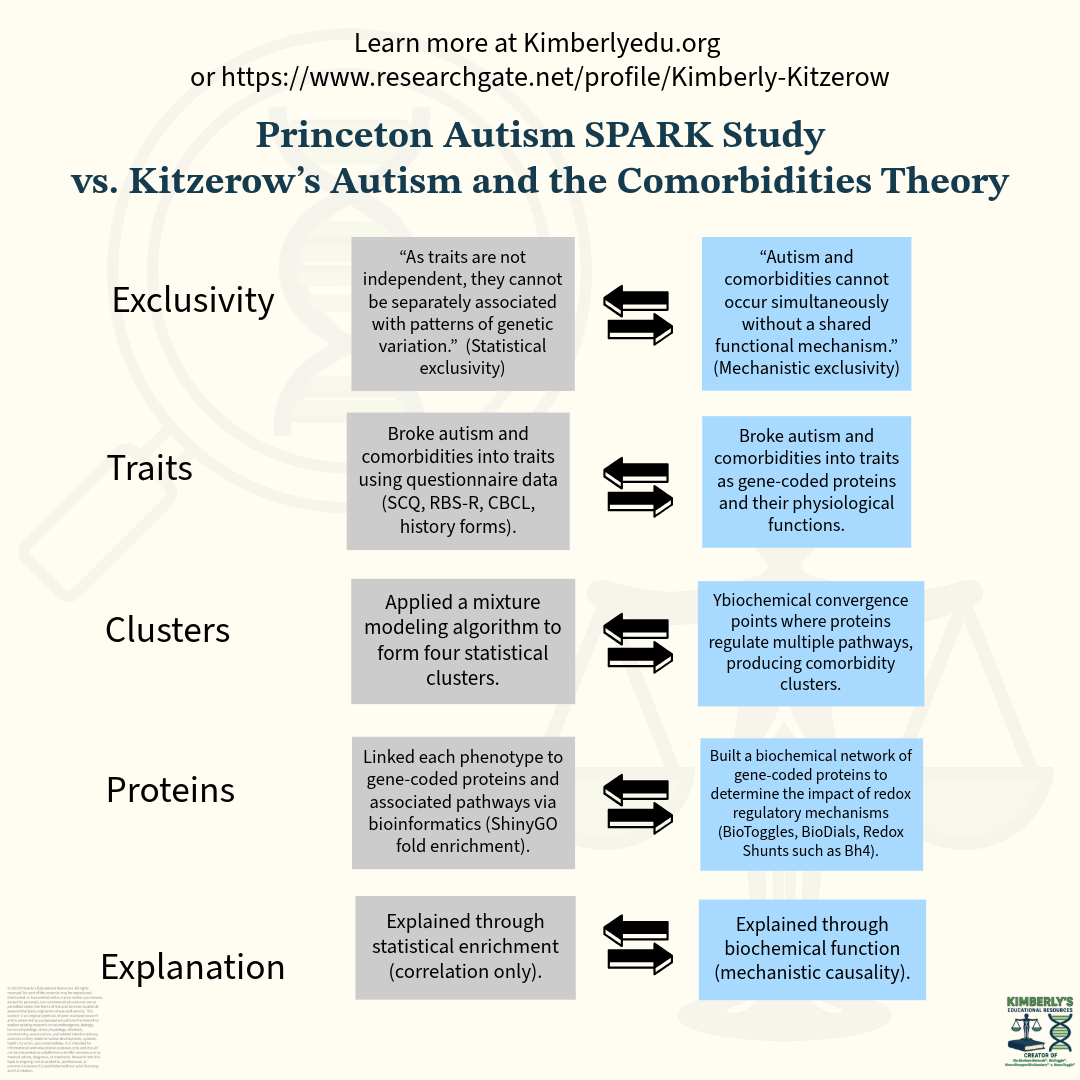
Exhibit A: Framework comparison showing parallel structures in exclusivity, traits, clusters, proteins, and explanations.
Exhibit B: Preprint versus Nature excerpts showing explicit mention of my hypothesis in the preprint and its removal in the published version.
Exhibit C: Exclusivity principle comparison showing their rephrasing of my functional exclusivity theory as statistical exclusivity.
Exhibit D: Methodological mirroring contrasting my mechanistic workflow with their statistical substitution.
Exhibit E: Timeline showing my prior dissemination, Princeton’s ShinyGO results dated June 3, 2024, and their submission to Nature on July 25, 2024.
Exhibit F: Published book excerpt (September 2023, Amazon) articulating the exclusivity principle prior to Princeton’s work.
Exhibit G: Visual documentation of my contribution to the exclusivity principle, shared publicly through timestamped videos and infographics, demonstrating my original framing of autism and comorbidity clusters.
Preprint: https://www.medrxiv.org/content/10.1101/2024.08.15.24312078v1
Nature Study: https://www.nature.com/articles/s41588-025-02224-z
Stanford: E/I Imbalance in the CSTL leading to Core Autism Traits
-
I petitioned Stanford’s Neurodiversity Project in January of 2024 for help, and they recently published a paper utilizing the downstream mechanism of upregulated transamination pathways from the BH4 Shunt dysregulating E/I balance in a piece of the CSTL to create an effective “cure” for autism’s classic core symptoms.
-
You can find my breakdown of the BH4 Shunt induced upregulated transamination pathways that dysregulate E/I balance in the CSTL, which is the brain circuitry for movement, habit formation, and reward, leading to classic autism traits published August 2024 here. You can watch the videos of me explaining this link for the first time June 2023 here and here.
The link between E/I imbalance in the CSTL and autism has been known for a while, I am the first to link it into a cohesive framework centered around what is causing this E/I imbalance.
You can find Stanford’s 2025 version here.
-
I created a biochemical framework for how autism and comorbid traits can happen based on how the body functions under stress states. The body is a very complex conveyor belt system, with proteins that manage each station. I came up with a theory that genetic mutations induce a stress response, then the domino impact along the conveyor belt activates, ultimately resulting in autism specific traits because of the impact on the speed and intensity that messages are sent in the brain circuitry responsible for movement, habit formation, and reward.
Stanford’s Neurodiversity project emailed me asking for more information about my work. Then, when I didn’t hear back I petitioned them for help on change.org. Now, they have put out a study with a new autism “cure” that targets the same mechanism I described. They created a drug that targets the speed and intensity that messages are sent in a specific section of the circuitry that controls movement, habit formation, and reward.

Northeastern/Harvard: The BioToggles and the Multiple Interdependent Regulatory Systems
-
The BioToggles are five interdependent regulatory systems that respond to physiological stress through conserved, coordinated activation and context-dependent allostatic resource reallocation to support survival.
Harvard’s 2025 Neuron paper “introduces” a conceptual shift in how allostasis is framed. Earlier publications consistently described allostasis as a single, integrated system distributed across interoceptive and visceromotor networks. In contrast, the 2025 paper reframes allostasis as the coordinated activity of multiple interacting regulatory systems and delineates the nervous system as a distinct regulatory component that is interdependent on other categorical regulatory systems. This categorical, multi-system framing does not appear in the group’s prior work and represents a substantive change in theoretical structure.
-
Supporting Materials:
Exhibit A Harvard: New multi-system regulatory framing
Quote: “In allostasis, many interacting regulatory systems collectively contribute to the survival of the organism.”
Explanation: First appearance of plural regulatory systems in Harvard’s work. Establishes a categorical multi-system architecture aligned with the BioToggles model.
Exhibit B Harvard: Prior unified allostatic system (October 2024)
Quote: “These results reinforce the existing evidence for a whole-brain system that supports the modeling and regulation of the body’s internal milieu.”
Explanation: Reinforces their historical single-system framing before the introduction of plural regulatory systems in 2025.
Quote: “Large swaths of brain tissue are centrally involved in allostasis, with the rest serving as association regions for the predictive, efficient regulation of the body.”
Explanation: Separates core allostatic regions from distinct body-regulatory regions, creating categorical regulatory functions rather than a unified system. This represents an early move toward multiple regulatory systems.
-
You can find the BioToggles framework here. It was first developed into the allosatic toggles structure here. The written explanation can be found in this paper. Trademark was filed April 2025, and the serial number is 99148316.
You can find their paper that outlines this mechanism here.
Their prior paper that doesn’t include the term regulatory system, or the novel concept of interdependent regulatory systems here.
UCSD: Naviaux’s New 3-Hit Model and My BioToggles Framework
-
Kitzerow: BioToggle States → BH4 Shunt → E/I Dysregulation → Comorbidities → Timing
Regulatory activation states
Situationally flipped: Environmental stressors transiently activate one or more BioToggles.
Chronically stuck: Resolution fails due to sustained stress or epigenetic constraint.
Genetically locked: Gene mutations impair regulatory reset, fixing BioToggles in an activated state.
Image Created April 2024 https://www.researchgate.net/publication/391327059_BioToggle_and_BioDial_Categorical_Delineation_A_Functional_Framework_for_Timing-Sensitive_Stress_Response_Mechanisms_in_Neurodivergent_Biochemistry
Primary biochemical mechanism
BH4 shunt trifurcation, governed by BH4-dependent regulation:
AAAH shunt: Diverts aromatic amino acids from dopamine, serotonin, and melatonin synthesis toward glutamate via stress-induced transamination, dysregulating the E/I balance in the circuitry responsible for movement, habit formation, and reward (CSTL) leading to core autism traits.
NOS shunt: BH4-regulated NOS uncoupling shifts signaling toward reactive oxygen species and downstream redox-sensitive epigenetic effectors, resulting in atypical physiological function and allostatic overload over time resulting in biochemically predictable autism comorbidities.
AGMO shunt: Impairs ether lipid cleavage required for endocannabinoid signaling, cellular repair, and detoxification.
Link: Memoir Discovering Autism and the Comorbidities Along the BH4 Pathway (Sept 2023 https://a.co/d/3DAOcuE) Links to my Researchgate Papers Published January 2024 - July 2025 can be found here https://www.kimberlyedu.org/researchgate-papers
Developmental timing sensitivity: April 2024 https://www.researchgate.net/publication/391327059_BioToggle_and_BioDial_Categorical_Delineation_A_Functional_Framework_for_Timing-Sensitive_Stress_Response_Mechanisms_in_Neurodivergent_Biochemistry
Emphasize critical developmental windows, where timing of activation of stress reprioritization alters the trajectory of development: April 2024 https://www.researchgate.net/publication/391327059_BioToggle_and_BioDial_Categorical_Delineation_A_Functional_Framework_for_Timing-Sensitive_Stress_Response_Mechanisms_in_Neurodivergent_Biochemistry
Neuroplasticity: Created a Neuroplasticity Framework NeuroToggle®
to reprioritize the development and function of these pathways during critical time periods for my nonverbal autistic daughter. I wrote a memoir Sept 2023 (https://a.co/d/3DAOcuE), and published two books on this topic published Oct 2024 (https://a.co/d/gYL4mze) and June 2025 (https://a.co/d/6tEQRhV)
Naviaux: 3-Hit CDR Model → PKU Example → E/I Dysregulation → Comorbidities → Timing
Activation sequence
1st hit: Genetic or epigenetic predisposition causing mitochondrial and metabolic hypersensitivity.
2nd hit: Early exposure to CDR (stress trigger)-activating environmental triggers during critical neurodevelopment.
3rd hit: Recurrent or persistent exposure for three to six months or longer, resulting in chronic CDR activation.
Biochemical illustration
Phenylketonuria (PKU) is used as an exemplar of metabolic disruption within the CDR framework (a BH4 deficiency disorder).
Accumulated phenylalanine and related metabolites impair mitochondrial metabolism and neurotransmission.
Neural outcome
Produces sustained E/I imbalance associated with autism traits.
Comorbidities
Framed as “autism with co-occurring medical conditions” (ACMC).
Attributed to persistent CDR-driven metabolic signaling competing with developmental energy demands.
Developmental timing sensitivity
Emphasize critical developmental windows, where timing of activation of stress reprioritization alters the trajectory of development.
Neuroplasticity: Neuroplasticity improves outcomes when interventions are started later in development, after a regression, or after the first symptoms appear.
You can find the link to Naviaux’s 2025 3-Hit Model here.
In addition to the highlighted textual evidence, there is also video evidence that dates back to 2023. This early stage work is not as polished, but that is evidence of theory evolution and development over time as the originator of this framework.
Video evidence can be located on my website via my living documentary (publicly documented time stamps): https://www.kimberlyedu.org/the-timeline-1
Legal requirements for publishing this framework have been met. Copyright is automatic upon publishing with a time stamp.
Trademark for NeuroToggle is 98952931 Trademark for BioToggle is 99148316
-
You can find the BioToggles framework here. It was first developed into the allosatic toggles structure here. The written explanation can be found in this paper. Trademark was filed April 2025, and the serial number is 99148316.
You can find my breakdown of the BH4 Shunt induced upregulated transamination pathways that dysregulate E/I balance in the CSTL, which is the brain circuitry for movement, habit formation, and reward, leading to classic autism traits published August 2024 here. You can watch the videos of me explaining this link for the first time June 2023 here and here. I also had a viral Instagram video August 30, 2024 breaking this down that you can watch here.
You can find my first mention of time regulated impact of stress on development here. I developed it over time turning it into the BioDials framework as described here.
You can find the link to Naviaux’s 2025 3-Hit Model here.
-
Conceptual Reframing: Naviaux has shifted from describing CDR as a unified metabolic response to describing autism and its comorbidities as a staged biological progression. This new structure reflects the BioToggle sequence of situationally flipped, chronically stuck when resolution fails, and genetically locked. None of this appears in his earlier work.
Adoption of the Autism and Comorbidities Framework: He now presents autism and its comorbidities as a single mechanistically connected pathological framework. His statement that ASD is associated with “an increased risk of several chronic medical conditions that co-occur with ASD” adopts the exact framing, and verbiage, that my Autism and the Comorbidities Theory introduced. He had never previously offered a mechanism that links autism traits and comorbidities into a single framework.
Mechanistic Adoption: The updated paper introduces BH4 dependent stress regulation of the excitatory to inhibitory balance. Naviaux states that prolonged activation “prevents the normal excitatory to inhibitory reversal in extracellular ATP and GABA signaling networks” and then links this failure to mitochondrial dysfunction and activation of microglia and astroglia. This mechanism is a core component of my BH4 Shunt model.
Use of PKU While Avoiding BH4: The update uses PKU as the model’s key developmental analogy and states that “the three hit model described above for ASD also applies to the current paradigm for the diagnosis and treatment of phenylketonuria (PKU)”. Earlier in the paper he explains that the enzyme responsible for phenylalanine metabolism requires the cofactor tetrahydrobiopterin. He writes that PAH converts phenylalanine to tyrosine using “iron, molecular oxygen, and the cofactor tetrahydrobiopterin”.
PKU is a BH4 dependent disorder. Using PKU to illustrate early biochemical disruption while avoiding any mention of BH4 within the autism mechanism is scientifically inconsistent unless the upstream mechanism is being intentionally avoided. The BH4 Shunt is the central biochemical mechanism I am known for, and PKU is one of its clearest clinical demonstrations.
Excitatory to Inhibitory Imbalance Integration: The updated paper positions failure of the excitatory to inhibitory reversal as a core downstream consequence of prolonged CDR activation. The relevant quote is that prolonged activation “prevents the normal excitatory to inhibitory reversal in extracellular ATP and GABA signaling networks”. He does not specify what this mechanism is. In my framework the BH4 Shunt upregulates transamination pathways that dysregulate this balance through unregulated glutamate activity and synthesis, dysregulatin the cortico-striatal-thalamic-loop that is responsible for movement, habit formation, and reward, thus resulting in core autism traits. This is one of the defining downstream effects of BH4 dysregulation in my published work. This mechanistic connection does not appear in earlier CDR publications.
-
Exhibit A: Naviaux Introduction of Three Hit Structure
Quote: “The three hits necessary and sufficient to cause ASD are: DNA predisposition, early exposure to CDR activating triggers, and recurrence or persistence of CDR activating triggers for at least three to six months.”
Explanation: This is the first appearance of a staged progression in CDR theory. It mirrors the stress regulated BioToggle sequence.Exhibit B: Naviaux Earlier Unified CDR Model
Quote: “The Cell Danger Response is a unified metabolic response conserved across evolution.”
Explanation: Earlier CDR work describes a single mechanism with no staged progression and no unified autism and comorbidity framework.Exhibit C: Naviaux Use of PKU Without BH4
Quote: “The protein made by the PAH gene is an enzyme that converts phenylalanine to tyrosine using iron, molecular oxygen, and the cofactor tetrahydrobiopterin.”
Explanation: He names BH4 in the context of PKU but omits BH4 entirely when applying the same developmental mechanism to autism, even though he states that PKU exemplifies his three hit model. The BH4 Shunt is the core mechanism in Kitzerow’s Autism and the Comorbidities Theory.Exhibit D: Naviaux Excitatory to Inhibitory Imbalance
Quote: “Prolonged CDR activation prevents the normal excitatory to inhibitory reversal in extracellular ATP and GABA signaling networks.”
Explanation: He adopts the E to I imbalance as a core outcome, which matches the downstream mechanism of the BH4 Shunt.

UFSC: Alexandra Latini and the BH4 Shunt
-
“Neurobiological hallmarks of ASD include abnormal synaptic connectivity, imbalances in excitatory–inhibitory signaling, and alterations in neurotransmitter systems such as serotonin, dopamine, glutamate, and gamma aminobutiric acid (GABA). Immune dysfunction, chronic inflammation, oxidative stress, and metabolic abnormalities, including mitochondrial dysfunction, have been described as critical factors. Considering that many of these molecular and signaling pathways may be dependent on the availability of 6R-L-erythro-5,6,7,8-tetrahydrobiopterin (BH4), alterations in its metabolism have been implicated in the pathogenesis of ASD.”
and provides no citation for the source.
Kitzerow’s Autism and the Comorbidities Theory (2023) is the first to mechanistically delineate how and why the BH4 Shunt physiologically manifests into autism and comorbid traits.
-
You can find the link to the first video version of Kitzerow’s Autism and the Comorbidities here, and the first paper here.
You can find Latini’s prior paper on BH4 and its role as a cofactor with no mention of a causal role in autism and the comorbidities, only a mention of autism in a section titled “Non-BH4-Linked Genetic Deficiencies of BH4 Metabolism” here. It was submitted to publishing March 2023, and published May 2023. Had she developed this theory prior, it would have been listed differently in that paper.
Latini’s updated 2025 paper with the BH4 Shunt Autism and the Comorbidities Hypothesis can be found here.
-
Use of this hypothesis as prior knowledge without citation
In their introduction, the authors listed this hypothesis as though it were already established knowledge, without mentioning where it came from. MDPI was contacted and Latini claims the hypothesis was a conclusion to this study. How can it be both hypothesis and a novel conclusion drawn from the results of the systematic review?Methodological and registration issues
The methods section acknowledges the review was not registered during the planning stage, which increases the risk of duplication. Their search strategy was limited to BH4, nitric oxide, and ASD, excluding other BH4-dependent pathways required to construct the complete Autism and the Comorbidities framework. Despite this, the paper presents the completed theory as though it had been their intent all along. There is also no public record of the work before their December 31, 2024 submission to MDPI, and it relied on a universal grant with no detailed proposal.Prior Work on BH4 Published Prior to Kitzerow’s Theory Lists BH4 in the “Non-BH4-Linked Genetic Deficiencies of BH4 Metabolism” Section: Latini’s prior paper on BH4 and its role as a cofactor with no mention of a causal role in autism and the comorbidities, only a mention of autism in a section titled “Non-BH4-Linked Genetic Deficiencies of BH4 Metabolism” here. It was submitted to publishing March 2023, and published May 2023. Had she developed this theory prior, it would have been listed differently in that paper.
-