

Understanding Autism. Explaining Comorbidities. Building Skills.
If your child's skills and behaviors seem inconsistent, ahead in some areas, stuck in others, there's a biological reason. Kimberly found it, and built a learning system that works with it.

Read NeuroToggle®
Learn the neuroplasticity-based framework for supporting autistic skill and behavior development.
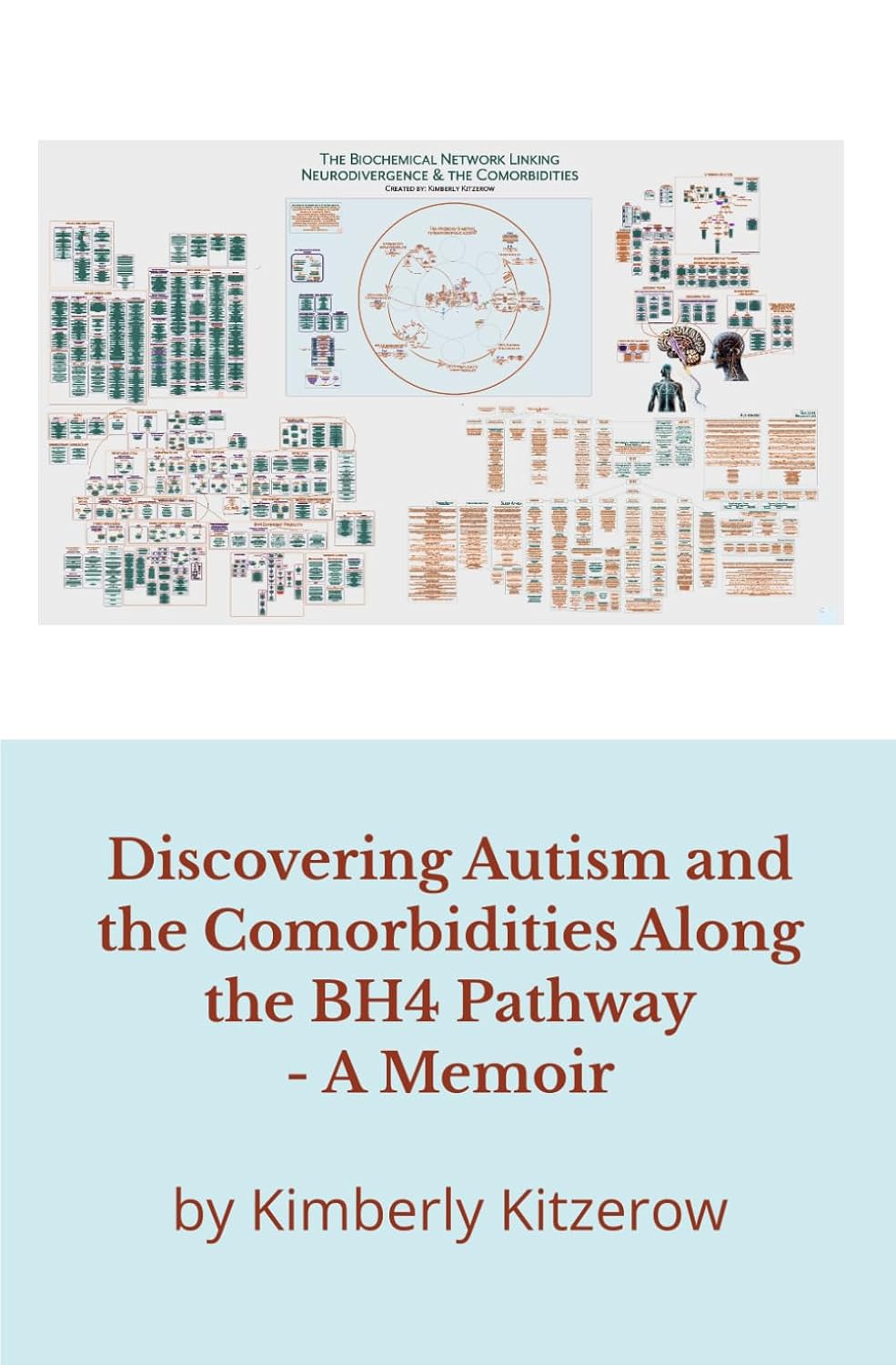
Read Discovering Autism and the Comorbidities
Kimberly's memoir, helping her nonverbal daugher speak and the development of the model.
View on Amazon →What’s Happening Biologically?
Genetic and epigenetic factors can keep the body’s stress-response system activated during neural development.
Within the model, biological resources are reallocated through the BH4 Shunt toward survival rather than typical neural-circuit development and systemic function.
The impact on neural development leads to autism traits, while the impact on systemic function leads to comorbid traits.
Why Do Different Phenotypes Develop?
Different patterns of impact across biologically interconnected pathways, occurring during different key developmental and biological stages, lead autism traits and comorbid traits to cluster into different phenotypes.
Current Progress
Tracking movement from theoretical and emerging evidence toward converging evidence, diagnostic development, and treatment development.
Choose the Path That Fits You
NeuroToggle®
In Kimberly Kitzerow’s Autism and the Comorbidities Cascade Model, autistic behaviors and skills develop differently because the body shifts into survival mode, changing how neural circuits develop. Neural circuits store the information needed to perform skills and behaviors.
As various neural circuits develop differently, autistic individuals can exhibit skill/behavior development at opposite ends of the same skill spectrum.
| Skill or Behavior | Possible Presentations |
|---|---|
| Reading | Hyperlexia or dyslexia |
| Communication | Hyperverbal or nonverbal |
| Sensory Processing | Sensory seeking or sensory avoiding |
| Learning | Savant-like skills or difficulty with daily living skills |
| Behavior | Impulsive or rigid |
| Interests | Broad interests or highly focused interests |
| Adapting to Change | Novelty seeking or resistance to change |
| Social Interaction | Highly social or socially withdrawn |
| Memory | Exceptional memory or difficulty with memory and recall |
Rather than treating autism as one fixed profile, NeuroToggle® helps identify the specific skills and behaviors each individual is exhibiting and provides neuroplasticity-based strategies to support their growth, development, and replacement when necessary.
BioToggle®
BioToggle® is a systems framework that organizes the biologically connected mechanisms underlying autism pathology, autism traits, comorbid traits, and why they commonly cluster together.
More than 95% of autistic individuals also experience at least one comorbidity.
This can include ADHD, gastrointestinal disorders, chronic pain, anxiety, connective tissue disorders, dysautonomia, immune differences, sleep disorders, and many other co-occurring conditions are common.
Autism Trait Pathways
| BH4 Dependent Pathways | Primary Function |
|---|---|
| BH4 Shunt | Central regulatory pathway underlying the autism trait cascade |
| AAAH Shunt | Catecholamine regulation and excitatory-inhibitory balance in neural circuits controlling movement, habit formation, reward, communication, and sensory processing |
| AGMO Shunt | Endocannabinoid signaling, stress signaling, lipid signaling, and neurodevelopment |
| NOS Shunt | Nitric oxide signaling, oxidative stress, mitochondrial function, synaptic function, and nervous system regulation |
Comorbid Trait Pathways
| Regulatory System Domain Activation | May Influence |
|---|---|
| Immune Regulation | Immune-related traits and inflammatory responses |
| Metabolic Regulation | Energy production, metabolism, gastrointestinal function, and fatigue-related traits |
| Cellular Repair | Connective tissue, extracellular matrix remodeling, healing, and tissue integrity |
| Nervous System Regulation | Autonomic function, pain regulation, sleep, migraine, and dysautonomia-related traits |
| Genetic Regulation | Epigenetic adaptation, gene expression, and long-term biological regulation |
BioToggle® brings these pathways together into one systems framework, helping explain why autism and comorbid traits often occur together.
The Jigsaw Puzzle Methodology™
One of the biggest challenges in autism research is making sense of thousands of seemingly disconnected findings.
Rather than relying solely on statistical correlation, Kimberly Kitzerow developed the Jigsaw Puzzle Methodology™ to identify functional pathological causation. She realized that you cannot figure out why a system is not working by comparing it to all the nearby systems. You first have to create the blueprint, then troubleshoot it.
So that is what she did. She created a biochemical network of human gene-coded proteins to serve as a biological blueprint, then compared biomarker findings against that blueprint to identify functional pathological causation.
Kimberly first applied the methodology to autism and its comorbidities, leading to the development of BioToggle®, a scientific framework explaining autism pathology, autism traits, comorbid traits, and the biological mechanisms that cause them to cluster.
Publicly Available for Independent Evaluation
Everything used to develop Kimberly Kitzerow’s frameworks has been made publicly available for independent evaluation.
Educator. Founder. Mother.
Kimberly Kitzerow developed the Jigsaw Puzzle Methodology™ while searching for answers for her nonverbal autistic daughter. That work led to BioToggle®, a scientific framework explaining autism pathology and comorbid traits, and NeuroToggle®, a neuroplasticity-based educational framework translating those discoveries into practical strategies for autistic skill and behavior development.