


Converging Evidence Report - Melillo’s 2026 Cascade vs Kitzerow’s 2023 Autism Trait Cascade
Leisman, Melillo & Alfasi Neuroimmune Cascade Report Card
This report evaluates whether the 2026 developmental neuroimmune cascade paper reflects independent synthesis or uncredited structural use of Kitzerow’s earlier autism and comorbidities cascade. Scoring is based on temporal precedence, dissemination gap, publication timeline, exposure likelihood, structural specificity, and institutional response.
Executive Summary
Condensed readout of the evaluative pattern reflected in this report.
Published in 2026 by Gerry Leisman, Robert Melillo, and Rahela Alfasi in the International Journal of Molecular Sciences.
The paper organizes autism through an upstream developmental/immune trigger, neuroimmune signaling, synaptic pruning, E/I balance, neural circuit maturation, network function, sensory and social outcomes.
The paper follows the broad cascade direction while leaving out the BH4 shunt, AAAH shunt, NOS shunt, AGMO shunt, and the biochemical branch structure that distinguishes Kitzerow’s model.
The concern is not isolated overlap in immune activation, microglia, pruning, E/I balance, or autism traits. The concern is directional architecture: upstream trigger to downstream autism-relevant developmental and behavioral outcomes.
Converging Evidence
Side-by-side architectural comparison of Dr. Melillo's earlier framework, Kitzerow's earlier ordered cascade, and Dr. Melillo's later developmental neuroimmune cascade.
What Is Being Compared
This comparison evaluates whether the developmental neuroimmune cascade represents a continuation of Dr. Melillo's earlier framework or a later reorganization into the same ordered cascade architecture already publicly presented by Kitzerow. The key issue is not shared mechanisms. The key issue is directional architecture.
Disconnected Kids (2009–2024)

Earlier Melillo framework centered on functional disconnection, hemispheric imbalance, sensory-motor development, retained primitive reflexes, and neuroplasticity.
developmental asymmetry → hemispheric imbalance → functional disconnection → sensory & motor differences → autism traits → neuroplasticity
The earlier framework explained autism primarily through uneven brain development, hemispheric specialization, sensory processing differences, retained primitive reflexes, and altered connectivity between neural regions.
Core Framework
• Developmental asymmetry between brain regions and hemispheres
• Functional disconnection affecting sensory, motor, cognitive, and behavioral development
• Retained primitive reflexes and sensory-motor dysfunction contributing to developmental challenges
• Neuroplasticity-based intervention intended to strengthen underdeveloped neural networks and improve function
Kitzerow's Model 2023–2024

Published cascade linking immune-domain dysregulation, BH4-centered pathway shifts, circuitry regulation, synaptic pruning, connectivity, social function, and neuroplasticity.
immune regulatory domain → BH4 shunt → AAAH / NOS / AGMO → E/I balance → synaptic pruning → connectivity → social/behavioral function → neuroplasticity
Kimberly's framework organizes autism and comorbid traits through immune-domain dysregulation and a BH4-centered biochemical middle that branches into circuitry regulation, pruning regulation, and connectivity regulation.
Core Framework
•AAAH → E/I imbalance the function and development in circuitry responsible for learning, memory, skills, and behaviors.
• NOS → redox-sensitive protein shunts including mTOR impact on synaptic pruning dysregulation.
• AGMO → lipid reallocation, endocannabinoid dysregulation, connectivity changes, and social function.
• Neuroplasticity functions as the corrective mechanism for dysregulated skill and behavior development.
Developmental Neuroimmune Cascade
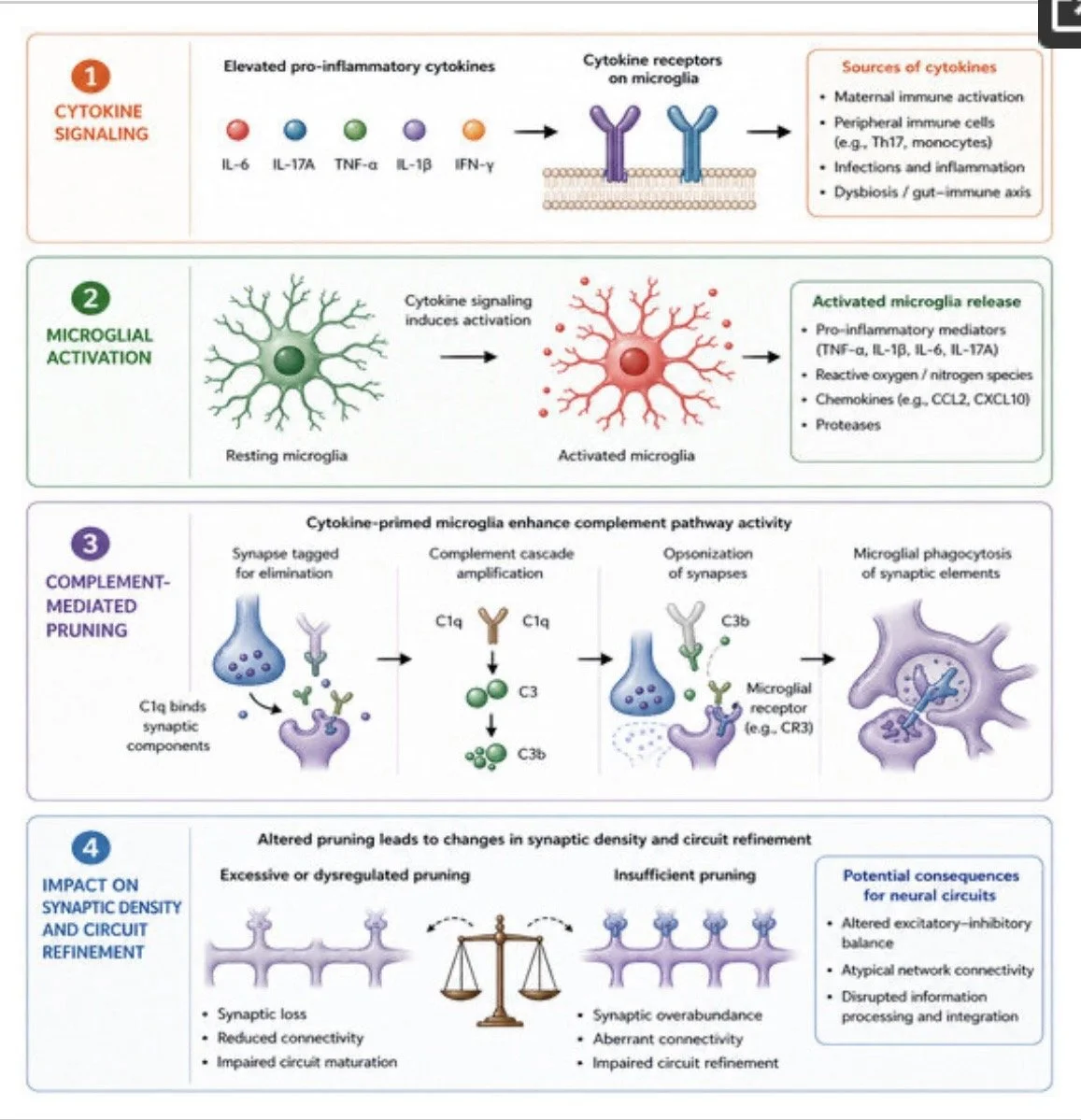
Published developmental neuroimmune cascade linking immune perturbation, cytokine signaling, complement activity, microglial activity, synaptic pruning, network maturation, and neuroplasticity.
immune perturbation → cytokine signaling → E/I balance → complement activity → synaptic pruning → connectivity → social/behavioral outcomes → neuroplasticity
The later framework expands into an immune-centered developmental cascade connecting immune perturbation to circuitry regulation, synaptic pruning, information processing, social outcomes, and neuroplasticity.
Core Framework
• Immune signaling → E/I imbalance affecting the circuitry responsible for information processing and retention.
• Complement activity → downstream regulation of synaptic pruning.
• Microglial activity → altered pruning and network maturation.
• Neuroplasticity functions as the corrective mechanism for information processing, learning, adaptation, and retention.
Concluding Interpretation
This is an ordered cascade. The alignment is sequential. The shift is architectural. Dr. Melillo's earlier framework centered on functional disconnection, hemispheric imbalance, sensory-motor development, and neuroplasticity-based intervention. Kitzerow's model publicly organized autism and comorbid traits through an immune-domain cascade containing circuitry dysregulation, synaptic pruning dysregulation, connectivity changes, downstream developmental outcomes, and neuroplasticity. The later developmental neuroimmune cascade reorganizes into a similar directional sequence: immune dysregulation → E/I imbalance → synaptic pruning dysregulation → altered connectivity and developmental outcomes → neuroplasticity. The primary difference is that Kitzerow's model contains the BH4-centered biochemical middle consisting of the AAAH, NOS, and AGMO branches, whereas the later Melillo cascade moves directly from immune mechanisms to downstream neural outcomes.
Documented Record
Chronological record relevant to precedence, publication sequence, and structural comparison.
Score Interpretation
Lower scores indicate higher concern. Higher scores indicate stronger evidence for independence.
Detailed Scoring Table
Six-factor report card formatted as a formal evaluation sheet.
Temporal Precedence
Framework predates study
Value: 1 dot — Kitzerow framework clearly predates the 2026 paper.
Why this score: Kitzerow’s cascade was publicly developed before this review was received, revised, accepted, and published in 2026. The later paper appears after the cascade architecture was already public.
Dissemination Gap
Time from framework release to study publication
Value: 1 dot — prolonged dissemination window.
Why this score: The public cascade predates the June 2026 paper by several years, creating a substantial window in which the framework, terminology, and architectural organization were publicly accessible.
Publication Timeline
Study derivation and journal timeline
Value: 1 dot — no disclosed independent derivation timeline.
Why this score: The article is a review organized through literature synthesis. It does not provide a prospective derivation record explaining how the authors independently generated the top-to-bottom cascade architecture before Kitzerow’s framework was publicly available.
Exposure Likelihood
Probability of access to the framework
Value: 3 dots — public exposure pathway, with field-specific accessibility.
Why this score: The framework was publicly available online before publication. The paper concerns the same cascade, and they used ai, inincreasing the likelihood that publicly disseminated framework material could have been encountered.
Structural Specificity
Overlap in architecture, mechanism sequence, and conclusions
Value: 1 dot — same top-to-bottom cascade structure with the biochemical middle omitted.
Why this score: The paper follows the same directional architecture from upstream developmental and immune perturbation to downstream autism-relevant traits: immune activation, microglial activation, synaptic pruning, E/I balance, network maturation, sensory/interoceptive processing, and behavioral outcomes. The concern is not isolated overlap. The concern is that the paper uses the cascade from top to bottom while omitting the BH4-centered biochemical middle that distinguishes Kitzerow’s model.
Institutional Response
Response after notice or correction opportunity
Value: 3 dots — no formal response documented in this report card.
Why this score: This category is held at the midpoint because no formal institutional investigation, correction, citation update, or author response is documented here. The score can be revised if a formal response occurs.
Final Interpretation
Bottom-line readout of the overall score pattern.
Interpretation
The paper receives an F because it presents autism through a developmental neuroimmune cascade that tracks the same top-to-bottom directional architecture already present in Kitzerow’s earlier public model. The paper begins with upstream developmental and immune perturbation, moves through neuroimmune signaling, microglial activation, synaptic pruning, E/I balance, circuit maturation, and network-level outcomes, then connects those processes to autism-relevant sensory, interoceptive, social, and behavioral traits. The most significant concern is that the BH4-centered biochemical middle of Kitzerow’s model is omitted while the broader cascade structure remains intact.
Studies Referenced in This Framework
The following studies correspond to the mechanisms mapped in the framework and are provided for direct review and comparison.
Studies are listed in relation to the framework components they correspond to.
- ESC models of autism with copy-number variations reveal cell-type-specific translational vulnerability View Study Here
- Tetrahydrobiopterin and Autism Spectrum Disorder: A Systematic Review of a Promising Therapeutic Pathway View Study Here
- Reticular thalamic hyperexcitability drives autism spectrum disorder behaviors in the Cntnap2 model of autism View Study Here
- Imaging Metabotropic Glutamate Receptor 5 and Excitatory Inhibitory Imbalance in Autism View Study Here
- Nitric Oxide-Mediated S-Nitrosylation of TSC2 Drives mTOR Dysregulation across Autism Models View Study Here
- AI-based autism identification from hyperspectral imaging detection of oxidative stress in pediatric red blood cells View Study Here
- Decomposition of phenotypic heterogeneity in autism reveals underlying genetic programs View Study Here
- A 3-hit metabolic signaling model for the core symptoms of autism spectrum disorder View Study Here