


Converging Evidence Report - UCSD/Naviaux 3 Hit Model
UCSD Converging Evidence Report Card
This report evaluates whether UCSD’s later 3-hit findings reflect independent derivation or uncredited use. Scoring is based on temporal precedence, dissemination gap, publication timeline, exposure likelihood, structural specificity, and institutional response.
Converging Evidence
Side-by-side architectural comparison of Naviaux’s original CDR model, Naviaux’s 2025 3-Hit expansion, and Kitzerow’s earlier ordered cascade.
What Is Being Compared
This comparison evaluates whether the 2025 3-Hit expansion reflects a simple continuation of the earlier CDR scaffold or a structural reorganization into the same ordered cascade Kimberly had already publicly disseminated. The key issue is not shared vocabulary. The key issue is directional architecture.
CDR Model 2013–2024
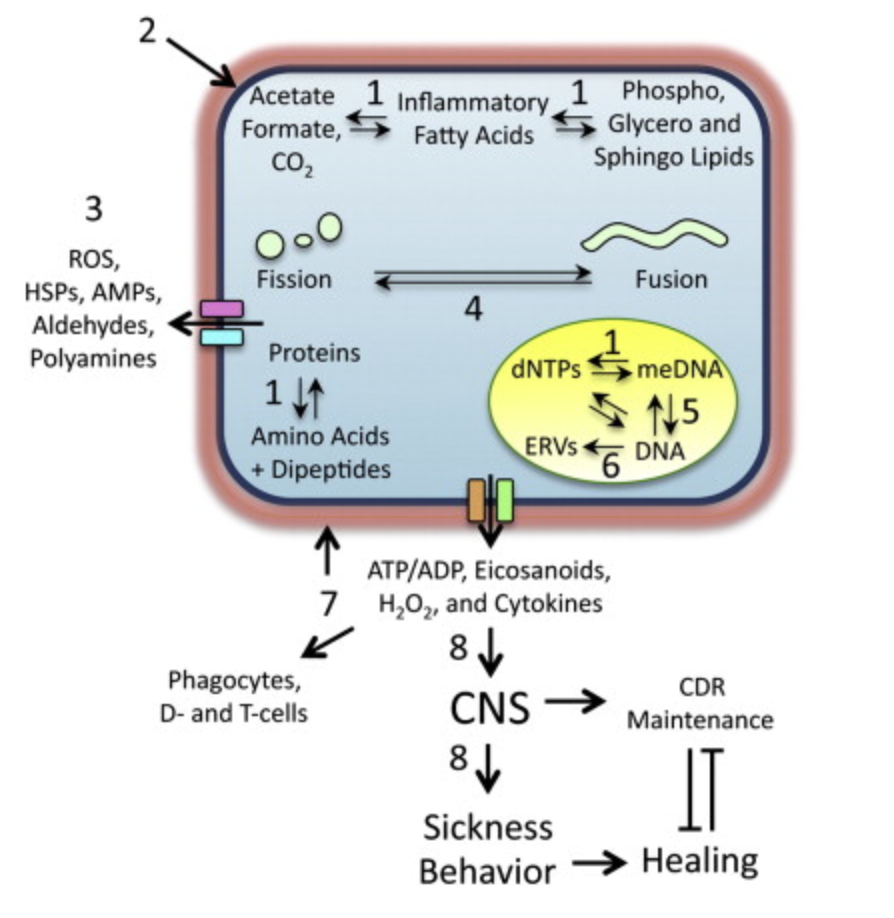
Published CDR model image showing the original Cell Danger Response scaffold before the later 3-Hit expansion.
Cell Danger Response → mitochondrial / metabolic shift → chronic multi-system disease
From 2014 through the May 2023 healing-cycle update, the model followed a CDR-centered architecture organized around mitochondrial signaling, metabolic shift, healing-cycle physiology, and chronic multi-system disease physiology.
This earlier scaffold, including the May 2023 healing-cycle update, did not formally include a defined 3-category stress taxonomy, a sequenced E/I dysregulation node, a structured autism and comorbidity simultaneity model, a downstream developmental timing node, or neuroplasticity as a terminal adaptive mechanism.
Kitzerow's Model 2023–2024

Published Kitzerow model image showing the earlier ordered cascade linking stress states, BioToggle pathway shifts, autism, comorbidities, timing, and neuroplasticity.
three-factor stress states → BH4 shunt trifurcation → mitochondrial / redox + E/I dysregulation → autism + predictable comorbidities → developmental timing → neuroplasticity
Kimberly’s framework was publicly structured as an ordered cascade integrating stress states, biochemical pathway shifts, redox and E/I dysregulation, autism with predictable comorbidities, developmental timing, and NeuroToggle.
This establishes the comparison point: the later 3-Hit expansion aligns with the same directional architecture already presented in the Kitzerow cascade.
3-Hit Model 2025
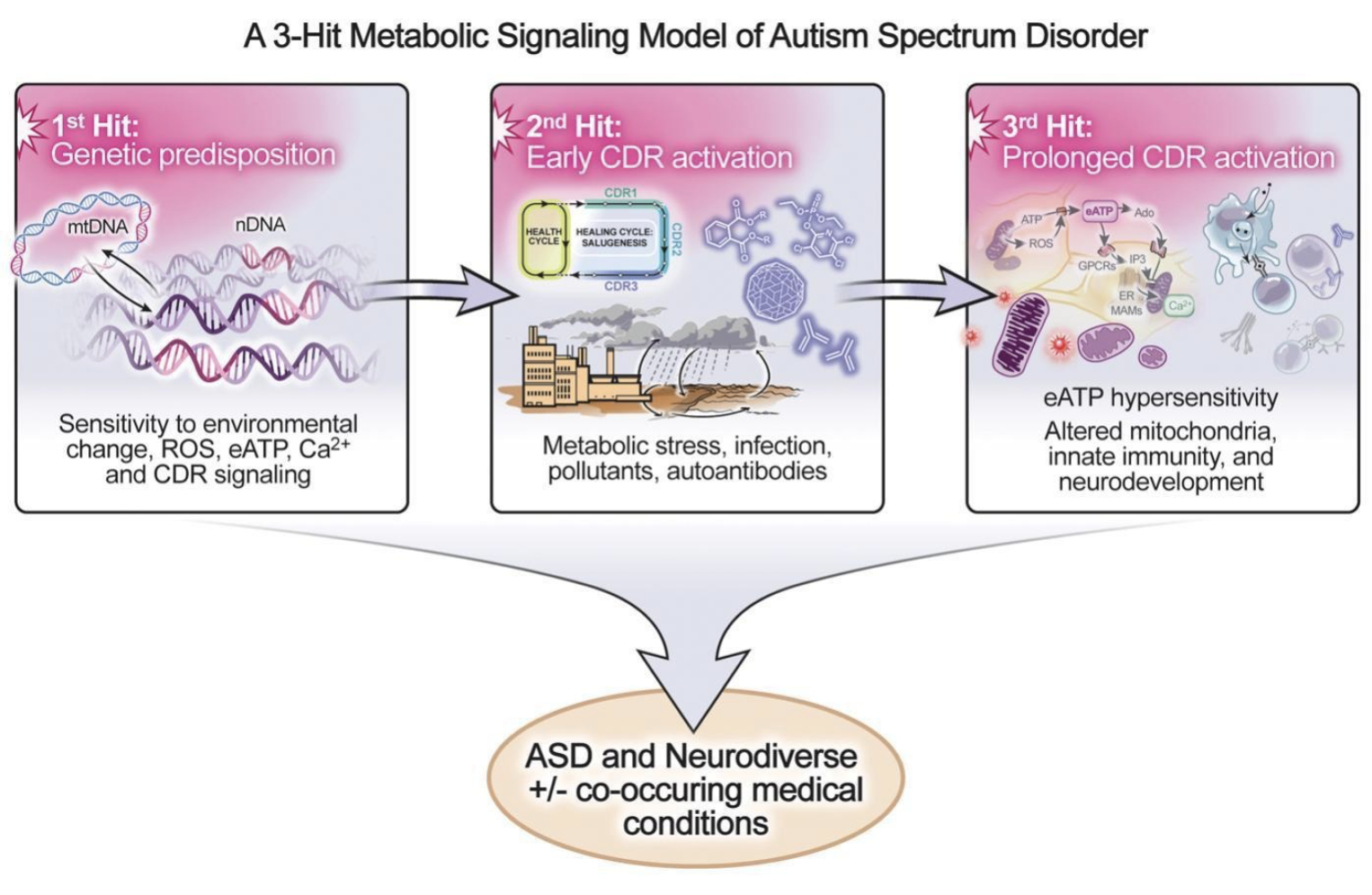
Published 3-Hit model image showing the later expansion into genetic, chronic, and situational stress categories.
genetic + chronic + situational stress → mitochondrial / metabolic shift → E/I dysregulation → autism + comorbidities → developmental timing → neuroplasticity relevance
The updated framework expands beyond the earlier CDR scaffold into a multi-node developmental cascade that now includes stress categorization, E/I dysregulation, autism with comorbidities, developmental timing, and neuroplasticity relevance.
The change is not merely additive. It reorganizes the model into a directional sequence that maps stress inputs to neurodevelopmental and adaptive outcomes.
Concluding Interpretation
This is an ordered cascade. The alignment is sequential. The shift is architectural. Naviaux’s earlier CDR model did not contain the full scaffold. The 2025 3-Hit expansion reorganizes into a directional progression that closely parallels Kitzerow’s previously disseminated framework.
Executive Summary
Condensed readout of the major evaluative patterns reflected in this report.
Naviaux’s earlier model remained centered on Cell Danger Response and mitochondria before shifting to a structured multi-node cascade in 2025.
The 3-hit sequence is presented through literature analysis rather than an independently articulated cascade built prospectively.
MedMaps invited Kitzerow as a special guest in 2024, and Naviaux had confirmed affiliation with that institutional orbit.
After contact and meeting with the vice chancellor, UCSD concluded that not enough plagiarism occurred to warrant investigation.
Documented Record
Chronological record of framework development, publication sequence, and institutional context relevant to this evaluation.
Score Interpretation
Lower scores indicate higher concern. Higher scores indicate stronger evidence for independence.
Detailed Scoring Table
Six-factor report card formatted as a formal evaluation sheet.
Temporal Precedence
Framework predates study
Value: 3 dots — framework predates study.
Why this score: Kitzerow’s public cascade development appears in 2023–2024, while Naviaux’s 3-hit expansion was released on December 9, 2025.
Dissemination Gap
Time from framework release to study publication
Value: 1 dot — dissemination gap greater than 12 months.
Why this score: The publicly developed cascade predates the December 9, 2025 UCSD 3-Hit Model release, with NeuroToggle established by January 2022 and the Autism and the Comorbidities Theoretical Model publicly released on May 6, 2023. Time from May 6, 2023 to December 9, 2025 is 948 days, establishing a prolonged dissemination window prior to the 3-hit model release.
Publication Timeline
Study start to journal submission
Value: 1 dot — no disclosed independent derivation timeline.
Why this score: Naviaux’s model was stable for over 10 years prior to the 2025 update, and no study is presented that resulted in an alternative cascade-level conclusion. No method section explains how the later literature synthesis selected or structured the new components, yet those updates align within the core nodes of Kitzerow’s cascade.
Exposure Likelihood
Probability of access to the framework
Value: 1 dot — confirmed affiliation pathway.
Why this score: MedMaps invited Kitzerow as a special guest in 2024, and Naviaux had confirmed affiliation with that orbit, establishing a direct exposure pathway beyond mere public availability.
Structural Specificity
Overlap in mechanism, structure, or conclusions
Value: 1 dot — same ordered cascade structure replicated.
Why this score: The later UCSD model follows the same directional progression of stress categorization, pathway disruption, downstream phenotype clustering, developmental timing, and neuroplasticity relevance rather than overlapping only at isolated mechanisms.
Institutional Response
Response after notification and publication changes
Value: 1 dot — dismissive response pattern.
Why this score: After contact and meeting with the vice chancellor, UCSD determined that not enough plagiarism occurred to warrant investigation.
Final Interpretation
Bottom-line readout of the overall score pattern.
Interpretation
UCSD’s score pattern concentrates toward the lower end because the earlier Naviaux model was stable for over a decade, the 2025 3-hit expansion mirrors the ordered cascade through literature synthesis rather than independent derivation, confirmed affiliation existed through MedMaps, and UCSD declined formal investigation after notice.
Full Cascade Replication
This section evaluates alignment at the level of the full cascade rather than individual mechanisms.
Kitzerow's Theoretical Cascade Model
The framework was structured as an ordered sequence integrating stress categorization, biochemical pathway shifts, neural circuit disruption, and downstream outcomes.
- 3-factor stress states (genetic, chronic, situational)
- BH4 Shunt trifurcation (AAAH, NOS, AGMO)
- Redox + mitochondrial + E/I dysregulation
- Autism traits + predictable comorbidities
- Developmental timing
- Neuroplasticity as a terminal adaptive mechanism
Documented in 2023 by Kitzerow.
3-Hit Expansion (Literature Analysis)
Naviaux’s earlier model centered on the Cell Danger Response without a sequenced multi-node cascade.
The 2025 expansion introduces a structured sequence derived through literature analysis:
- 3-hit stress model (genetic, chronic, situational)
- Mitochondrial/metabolic shift
- E/I dysregulation
- Autism + comorbidities
- Developmental timing
- Neuroplasticity relevance
The alignment occurs at the level of ordered structure, not isolated mechanisms. The sequence of stress categorization, pathway redirection, circuit disruption, phenotype clustering, developmental timing, and neuroplasticity appears in the same directional progression.
This reflects replication of a structured cascade integrating multiple biological systems rather than overlap in individual components.
Studies Referenced in This Framework
The following studies correspond to the mechanisms mapped in the framework and are provided for direct review and comparison.
Studies are listed in relation to the framework components they correspond to.
- ESC models of autism with copy-number variations reveal cell-type-specific translational vulnerability View Study Here
- Tetrahydrobiopterin and Autism Spectrum Disorder: A Systematic Review of a Promising Therapeutic Pathway View Study Here
- Reticular thalamic hyperexcitability drives autism spectrum disorder behaviors in the Cntnap2 model of autism View Study Here
- Imaging Metabotropic Glutamate Receptor 5 and Excitatory Inhibitory Imbalance in Autism View Study Here
- Nitric Oxide-Mediated S-Nitrosylation of TSC2 Drives mTOR Dysregulation across Autism Models View Study Here
- AI-based autism identification from hyperspectral imaging detection of oxidative stress in pediatric red blood cells View Study Here
- Decomposition of phenotypic heterogeneity in autism reveals underlying genetic programs View Study Here
- A 3-hit metabolic signaling model for the core symptoms of autism spectrum disorder View Study Here