Overview

Understanding Autism. Explaining Comorbidities. Building Skills.

A body of work that explains how genes and epigenetic changes can shift biological pathway activity during development and throughout life, affecting brain development and body function, driving clusters of autism and comorbid traits, and identifying points for intervention.

Brain Body
Did you know? More than 95%

of autistics have at least one co-occurring condition.

Brain + body
understood together
Homeostasis Maintains typical balance
Allostasis Restores balance under threat
Core Hypothesis “Autism is a genetically locked stress response.”
Support the Work

Help Preserve Kitzerow’s Priority of Discovery

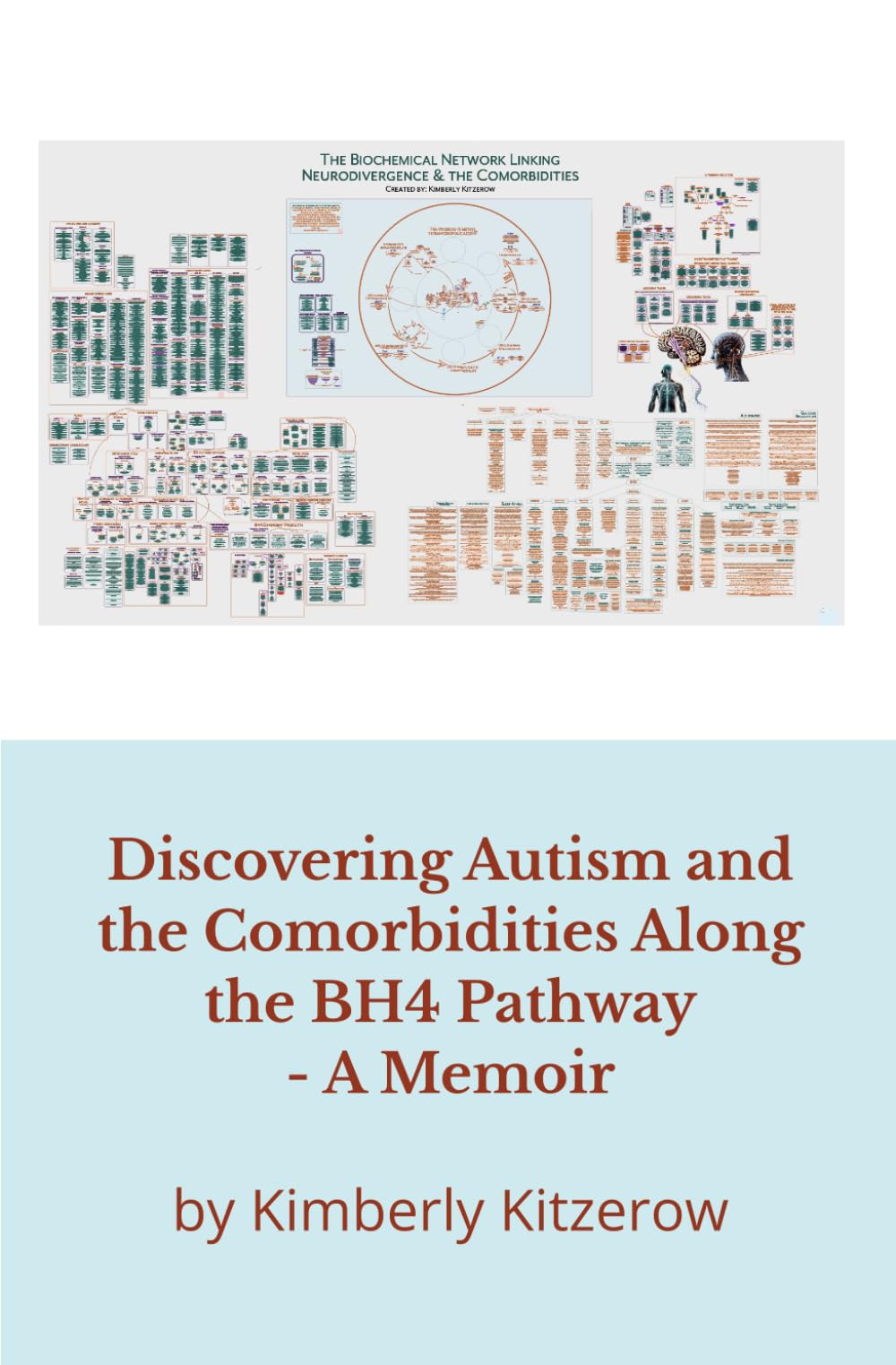
Published in 2023, Discovering Autism and the Comorbidities Along the BH4 Pathway documents Kitzerow’s journey helping her nonverbal autistic daughter develop speech and the Cascade that followed.

Review Kitzerow’s attribution rubric →

What Makes This Model Unique?

It Connects Biochemical Shunts Into One System

Earlier autism research often identified autism-associated genes or studied individual affected biochemical pathways. Kitzerow’s 2023 Cascade used bioinformatics and computational analysis to examine how those biological findings may connect across the brain and body.

Metabolic Shunting

Under stress, biochemical activity can be diverted from its typical homeostatic route into alternative allostatic pathways.

System-Wide Shunting

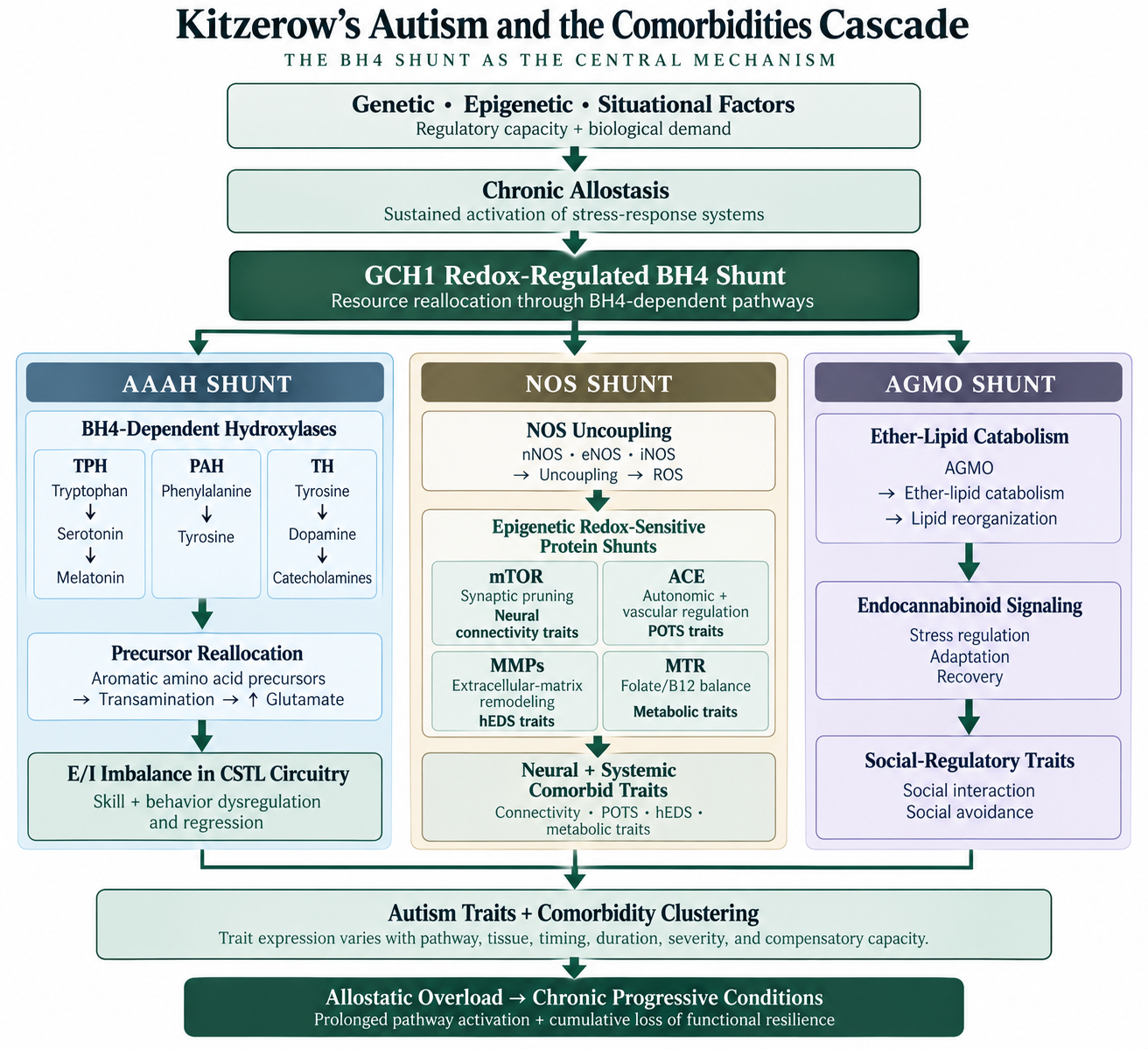
The Cascade proposes that allostasis coordinates shunting across regulatory systems through the BH4 Shunt.

Genes → Proteins → Pathways

Genetic and epigenetic changes affect gene-coded proteins, which alter biochemical pathway activity and downstream function.

Timing Shapes the Traits

What drives the response, which pathways shift, when they shift, and how long they remain altered may shape resulting traits.

The Systems

Two Systems Built From the Work

NeuroToggle® represents Kitzerow’s primary professional focus in education and skill development. BioToggle® grew from her separate investigation into the biological relationships between autism and its comorbidities.

Future Directions

From Understanding to Testing

The Cascade identifies biological nodes that can be investigated experimentally.

The model is intended to organize relationships, generate predictions, and provide a framework that can be tested, refined, or falsified as research develops.

Follow the Research

See What Has Been Tested and What Remains Unknown

The public Progress Tracker separates theoretical predictions, emerging evidence, converging evidence, potential translation, and remaining research gaps.

View the Progress Tracker →
Frequently Asked Questions

Questions About the Cascade

Clarifying the development, scientific status, testing, falsifiability, clinical implications, and publication status of Kitzerow’s Autism and the Comorbidities Cascade.

Does Kimberly Kitzerow recommend using the Autism and the Comorbidities Cascade to treat autism because she helped her daughter develop speech?

No. This conflates Kitzerow’s educational work with her later synthesis of biological data.

Kitzerow helped her daughter develop speech using principles that became NeuroToggle®, a neuroplasticity-informed instructional framework. NeuroToggle is based on experience-driven learning: instruction creates experiences that produce activity-dependent changes in neural circuits, so teaching strategies can be matched to the types of neural-circuit changes involved in learning skills and behaviors. This was educational skill development, not medical treatment using the Cascade.

Kitzerow’s synthesis of biological data on autism and its comorbidities began after she helped her daughter develop speech. Her experience prompted her to investigate why autism traits and physiological comorbidities frequently occur together.

She began synthesizing existing biological research, proposed the BH4 Shunt hypothesis, and developed the Jigsaw Puzzle Methodology to test it by constructing a species-level biochemical network of human gene-coded proteins and comparing autism-associated biomarkers against that reference. The analysis identified a broader pattern of biochemical pathway shunting consistent with the hypothesis.

From this work, BioToggle® describes the biological relationships among interacting regulatory and temporal systems and how those relationships influence protein and pathway activity. The Autism and the Comorbidities Cascade maps the predicted downstream outcomes of those relationships, including autism-associated traits, physiological comorbidities, and their clustering.

The Cascade remains a young scientific theoretical model. Since it was documented in 2023, subsequent research directly testing predicted mechanisms, investigating potential diagnostic applications, and therapeutically perturbing predicted pathways has produced findings consistent with relevant predictions. This growing body of direct and converging evidence provides increasing support for the model, but does not make it final.

Future evidence could refine, modify, or falsify individual mechanisms or the broader theoretical structure. Kitzerow maintains a public Progress Tracker so emerging evidence, direct tests, remaining research gaps, and potential falsification can be evaluated against the model’s documented predictions.

Research into diagnostic criteria, biomarkers, therapeutic targets, and treatments related to mechanisms predicted by the Cascade is already occurring. However, research-stage diagnostic or therapeutic investigation is different from an established clinical protocol. Translation requires substantially more research, replication, clinical evaluation, and regulatory review where applicable.

Kitzerow does not provide individual medical advice. Medical diagnosis and treatment decisions must go through appropriately licensed healthcare professionals. The Cascade is publicly available to facilitate understanding, scientific evaluation, testing, and potential future translation, not as instructions for self-diagnosis or self-treatment.

In short: Kitzerow helped her daughter develop speech through a neuroplasticity-informed educational system, not through medical treatment. Her biological investigation came afterward. NeuroToggle® is educational. The BH4 Shunt is the initial biochemical hypothesis, the Jigsaw Puzzle Methodology was used to test it, BioToggle® describes biological relationships between systems, and the Cascade maps their predicted outcomes.

Has the Autism and the Comorbidities Cascade been scientifically tested?

Yes, components and predictions of the model have subsequently been directly tested.

The Autism and the Comorbidities Cascade was developed in 2023 as a falsifiable theoretical model with specified biological mechanisms, relationships, and predicted downstream effects.

Subsequent studies have directly tested or therapeutically perturbed mechanisms corresponding to predictions documented in the 2023 Cascade, with the reported results to date consistent with those predictions.

These findings provide prospective support where the relevant prediction was documented before the independent experimental result became available. They are particularly informative when an intervention or perturbation produces the downstream biological effect predicted by the model because this tests more than a cross-sectional association.

The results do not make the entire Cascade permanently established or immune to falsification. Rather, they represent evidence that the model has survived empirical tests of specific predictions while accumulating converging support for its proposed architecture.

Other components remain available for direct testing, and contradictory future evidence could require revision or rejection of individual nodes, relationships, or broader portions of the model.

Has the Autism and the Comorbidities Cascade been scientifically validated?

The Cascade has accumulated supporting evidence while remaining subject to continued testing.

Since its development began in 2023, its proposed structure has remained unfalsified as it has been evaluated against direct testing of specific components and a growing body of converging independent evidence.

Findings consistent with individual nodes, mechanisms, relationships, and predictions provide support for those portions of the model and, where they preserve the predicted architecture, increase support for the broader framework.

This does not mean that every relationship within the Cascade has been experimentally established or that the model should be treated as final. The purpose of an early-stage theoretical model is to generate testable predictions that can be progressively evaluated.

The Cascade therefore remains open to refinement, modification, or falsification as new evidence becomes available, as does any scientific model.

Current status: The model has progressed beyond its initial theoretical formulation through accumulating direct and converging evidence, while further independent experimental testing is needed to determine the strength and limits of the complete framework.

Is Kitzerow’s Autism and the Comorbidities Cascade falsifiable? If so, does Kitzerow specify what would falsify it?

Yes. Kitzerow explicitly defines falsification criteria at both the individual-node and whole-model levels and publicly documents the model’s performance against those criteria.

For individual nodes, Kitzerow specifies three primary routes to falsification or revision: biomarker evidence, if the predicted dysregulation is not observed when the relevant biological state is measured; trait classification, if measured dysregulation does not correspond to the predicted downstream effects or trait patterns; and biological mechanism, if the proposed protein function, pathway relationship, regulatory mechanism, feedback relationship, or biological effect is demonstrated to be inaccurate.

At the model level, the Cascade would be challenged by repeated failure of its broader prediction that dysregulation within the proposed system produces biologically traceable and distinguishable patterns of downstream effects and traits.

These criteria are not presented only as hypothetical standards. Kitzerow maintains a public Progress Tracker documenting falsification attempts, direct tests of individual mechanisms and predictions, converging evidence, and remaining research gaps as the model develops.

This allows readers to compare the model’s previously documented predictions with subsequent experimental findings and evaluate where evidence supports, challenges, or requires refinement of the proposed structure.

Direct tests and converging evidence available to date have remained consistent with the relevant predictions evaluated. That status is provisional. Future contradictory evidence could require revision or falsification of a node, relationship, mechanism, or, if sufficiently central and reproducible, the broader Cascade.

If the Cascade has not been falsified, does that prove it is correct?

No scientific model becomes permanently “proven” because it has survived testing.

The relevant question is whether its predictions continue to withstand attempts at falsification and whether new evidence increases or decreases explanatory and predictive support for the model.

To date, the Cascade has retained its proposed structure through the evidence evaluated against it. That evidentiary status can change.

A future finding that contradicts a node, mechanism, predicted relationship, or broader model-level prediction would require evaluation and, depending on the result, could require refinement or falsification of part or all of the model.

Why isn’t Kitzerow’s Autism and the Comorbidities Cascade peer reviewed?

Kitzerow is currently pursuing enrollment in a PhD program and seeking a professor whose expertise aligns with the next stage of the research, particularly protein induction under regulatory-system redox activation and temporal-system influences. This would provide an academic setting for deeper investigation of the biological mechanisms identified through the Cascade and may eventually lead to journal publication.

For the time being, however, Kitzerow feels strongly that the model should remain openly accessible because of the biological coherence exhibited across the evidence evaluated thus far. The Cascade, its proposed mechanisms, predictions, evidence, and falsification criteria are therefore freely available through ResearchGate and her website for review, testing, and continued scientific investigation. She may choose to submit the Cascade or research arising from it to a scientific journal as the work develops.

Journal peer review and empirical testing serve different purposes. Peer review is part of the publication process. A journal manuscript is typically evaluated by two to three reviewers selected or invited by the journal’s editors, who assess the methodology, reasoning, evidence, and conclusions before an editorial decision is made. Reviewers generally do not independently repeat the research to determine whether its findings replicate.

Replication instead examines whether a finding, mechanism, or prediction continues to hold when investigated again, particularly with new data or by independent researchers. Journal publication is not itself an empirical test of a model. Scientific confidence develops as testable predictions are evaluated against evidence, subjected to further investigation, replicated where possible, and revised when findings do not hold.

Accordingly, the Cascade not currently being journal peer reviewed does not mean it has gone without review or testing. Since its documentation in 2023, mechanisms and predictions within the model have been examined through subsequent research, including direct mechanistic testing and therapeutic perturbation.

Kitzerow maintains a public Progress Tracker so these findings, remaining research gaps, and potential falsification can be evaluated against the model’s previously documented predictions. The papers documenting development of the model are also available through the ResearchGate Papers page.

The Cascade is therefore best described as an openly available theoretical model that has not yet been submitted for journal peer review. Its proposed mechanisms remain available for continued scientific scrutiny, empirical testing, replication, refinement, and potential falsification as the research develops.

About Kimberly Kitzerow

Educator Focused on Learning and Neurodivergence

Kimberly Kitzerow is an educator whose primary professional work focuses on learning, skill development, instructional strategy, and neuroplasticity. NeuroToggle® grew from that area of expertise.

Her biological research began separately after she became interested in why autism and physiological comorbidities frequently occur together. After identifying a potential pattern while synthesizing existing research, she developed a methodology for testing that pattern against available biological data using bioinformatics and computational analysis. The resulting theoretical work remains publicly accessible to support understanding, scientific examination, and further research.

Contact

Contact Kimberly Kitzerow

Education, research, academic collaboration, media, or speaking inquiries

NeuroToggle® is an educational system. BioToggle® and Kitzerow’s Autism and the Comorbidities Cascade are theoretical frameworks for understanding and investigating biological relationships associated with neurodivergence. They do not constitute individual medical advice, diagnosis, or treatment. Medical decisions should be made with appropriately licensed healthcare professionals.