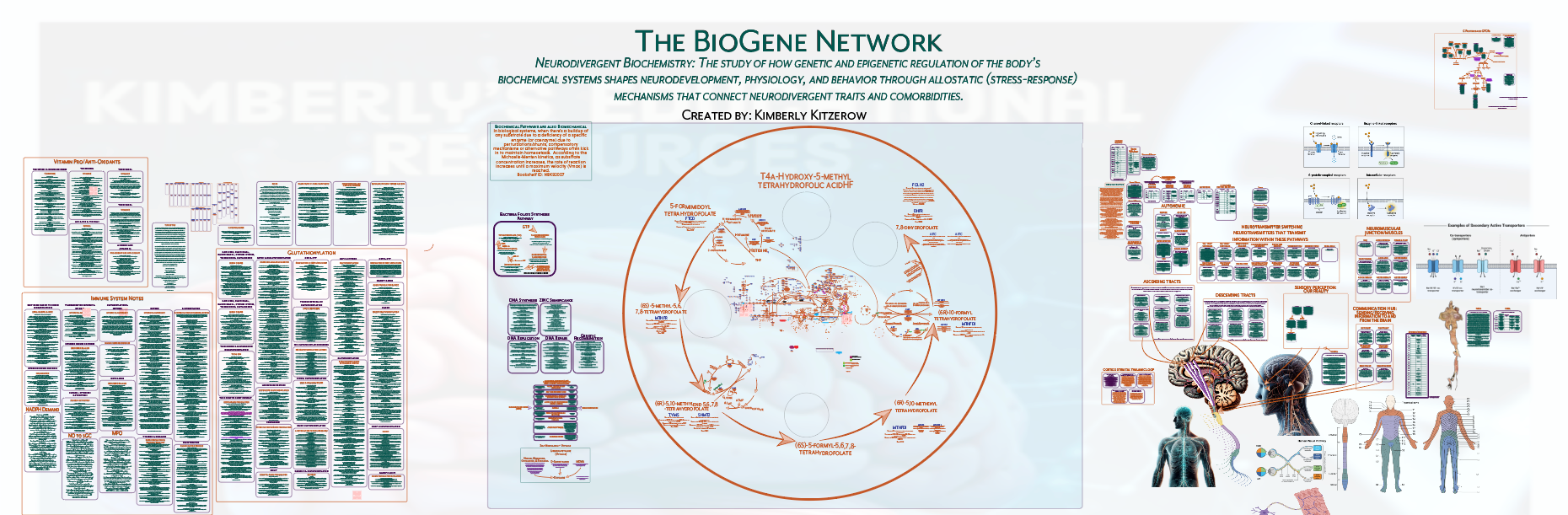
Response to Existing Biochemical Autism Pathology Models

Link to Kitzerow's Autism and the Comorbidities Theory

The difference between Kitzerow’s Autism and the Comorbidities Theory and prior biochemical models is not whether biochemical abnormalities exist in autism biomarkers, but how and why those abnormalities arise, how they are organized, and what they imply mechanistically.

Essentially, it’s “what’s the biochemical cascade that can mechanistically cause autism traits?”

Kitzerow’s Autism and the Comorbidities Theory is the first to delineate the BH4 Shunt as the central organizing mechanism that mechanistically explains how upstream and downstream biochemical factors converge to produce autism traits and systemic comorbidities simultaneously.

Video Response to Existing Biochemical Autism Pathology Models

Kimberly’s Educational Resources recognizes that many researchers and clinicians have proposed biochemical, metabolic, and immunological models related to autism and its associated comorbidities. These models reference a wide range of mechanisms, including mitochondrial dysfunction, redox imbalance, immune activation, neurotransmitter dysregulation, and metabolic stress responses. The existence of prior and parallel work in this area is acknowledged and respected.

The contribution of Kitzerow’s Autism and the Comorbidities Theory is not the claim that biochemistry is newly involved in autism, nor that prior models fail to address causation. Many established researchers examine why biochemical dysregulation arises. The distinction lies in how the mechanism of dysregulation is structured, centralized, and explained.

This framework centers tetrahydrobiopterin (BH4) as a unifying regulatory resource whose redistribution under stress organizes downstream biochemical effects across multiple systems. Rather than treating BH4-related changes as one of many parallel contributors, this model places BH4 shunting at the center of the regulatory architecture.

This work represents a cohesive biochemical cascade model, not a claim of discovery of BH4 itself, nor a dismissal of prior research. The novelty lies in the way existing biochemical findings are organized into a single explanatory mechanism.

Many established frameworks examine autism and neurodivergence through biochemical, metabolic, immune, or genetic mechanisms. Kitzerow’s Autism and the Comorbidities Theory differs not in recognizing these mechanisms, but in how BH4 shunting is classified, constrained, and how BH4 dependent pathways are reallocated downstream/upstream to define neurotype and comorbid profiles.

This framework distinguishes autism and neurodivergence by the source and persistence of BH4 shunting, rather than by symptoms alone.

Core Organizing Principle

In this model, BH4 shunting is the governing mechanism. The defining distinction between neurotypes is why the shunt exists and how long it persists. In this framework, a BH4 shunt refers to the forced reallocation of limited BH4 resources away from typical developmental and regulatory functions toward stress-adaptive pathways. Genetic, chronic, or situational stressors constrain BH4 availability, BH4 is shunted toward survival pathways, redox-sensitive systems shift together, and autism traits and comorbidities emerge in parallel.

  • Genetic BH4 shunting produces autism.
    Autism is defined by a genetically constrained BH4 shunt that is present across development and organizes neurological and systemic regulation at baseline.

  • Chronic or situational BH4 shunting produces neurodivergence more broadly.
    Broader neurodivergence arises when sustained physiological stress, illness, environmental load, or prolonged activation drives BH4 redistribution without a fixed genetic constraint. These shifts may be persistent or context dependent.

  • ADHD reflects genetic or epigenetic alterations in allostatic proteins.
    ADHD is not defined by primary BH4 shunting. It arises from alterations in proteins that govern the transition between activation and recovery states, resulting in difficulty appropriately activating and efficiently resolving the stress response.

Autism is therefore defined as a genetically constrained BH4 shunt present across development, while other forms of neurodivergence reflect non-genetic BH4 shunting driven by environmental load, chronic stress, illness, or sustained physiological demand

Together, these distinctions explain why autism, ADHD, and broader neurodivergence can share overlapping traits and biomarkers while remaining mechanistically distinct within a single regulatory framework..

This mechanism remained obscured because BH4 is involved in multiple systems simultaneously and has historically been studied in isolated pathways rather than as a shared regulatory resource.

The distinguishing features of this framework are:

  • A BH4 shunting model in which dysregulation arises from the reallocation of BH4 under stress rather than from isolated pathway failure

  • A clear distinction between three sources of BH4 shunting, situational stress, chronic allostatic stress, and genetic or epigenetic constraints, each producing different but overlapping biochemical outcomes depending on duration and regulatory system activation

  • An emphasis on the downstream consequences of BH4 redistribution, including coordinated redox-sensitive protein shifts, neurotransmitter imbalance, immune activation, and metabolic disruption

  • A unified explanatory structure that accounts for why multiple systems shift together and why autism traits and systemic comorbidities so often co-occur

Through original biochemical network construction and analysis of autism-associated biomarkers, this work delineated a BH4 resource trifurcation in which BH4 availability is redistributed across competing biochemical demands. This redistribution initiates a directional kinetic flow that governs multiple downstream effects rather than representing independent or unrelated dysfunctions.

Within this framework, autism biomarkers are interpreted not as static abnormalities or secondary consequences, but as the direct output of a regulated biochemical reallocation process operating under allostatic load.

Specifically, the framework delineates:

  • BH4 shunt-associated upregulation of transamination pathways contributing to dysregulated excitatory and inhibitory signaling within cortico-striato-thalamo-limbic circuitry

  • Concurrent activation of redox-sensitive protein shunts across immune, metabolic, cellular repair, and neurotransmitter systems due to shared regulatory constraints

  • The co-occurrence of systemic comorbidities as an emergent property of coordinated redox-driven protein shifts rather than as unrelated secondary conditions

These mechanisms were identified through construction of a biochemical network and comparing autism biomarkers via computational systems analysis. This model was created through a bottom-up, systems-level analysis of biochemical kinetics and protein function. Existing literature is used to contextualize the framework after its development, not to derive its core mechanisms. The development of this work was documented in real time through a public record, including a long-form overview documentary.

While individual components of these pathways may appear independently within prior research, the interpretation of their coordinated activation, shared dependence on BH4 availability, and unified kinetic organization as a single regulatory cascade is original to this framework. Kimberly’s Educational Resources does not claim exclusivity over the study of autism biochemistry, but it does assert authorship over the specific conceptual architecture, network delineation, and explanatory model articulated under Kitzerow’s Autism and the Comorbidities Theory.

Kimberly’s Educational Resources welcomes thoughtful scientific discussion when claims are represented accurately and in good faith. This section exists to clarify interpretive scope, methodological focus, and the specific contribution of this framework, and to prevent mischaracterization of its intent or origins.

Amy Yasko

Main difference: No BH4 shunt core mechanism, regulatory systems framework, or redox-sensitive protein shunt architecture, with enzymes and biomarkers addressed as independent checkpoints influenced by toxins and SNPs.

How her framework is organized:
Yasko’s work centers on inherited polymorphisms affecting methylation, transsulfuration, and detoxification pathways. Autism related traits are explained through pathway inefficiencies that alter biochemical throughput and can be supported or bypassed.

How Kitzerow’s framework differs:
Kitzerow’s Autism and the Comorbidities Theory does not organize autism around pathway inefficiency or correction. It defines autism as genetic BH4 shunting, meaning BH4 allocation is structurally constrained from development onward. Methylation and transsulfuration changes are interpreted as downstream consequences of that constraint rather than primary causes.

Comparison With Other Biochemical Frameworks

Robert Naviaux

Main difference: Proposes a mechanistic theory based on altered cell behavior rather than the underlying molecular biology of regulatory system stress responses, without a BH4 shunt mechanism or redox-driven E/I imbalance in neural circuitry (prior to the 2025 three-hit update).

How his framework is organized:
Naviaux’s original Cell Danger Response framework is organized at the cellular signaling level and is primarily environmental and state based. It explains autism as a condition in which cells remain in a defensive metabolic state following environmental or physiological stressors such as infection, immune activation, toxins, or injury. It explains autism as a condition in which cells remain in a defensive metabolic state due to disrupted mitochondrial and purinergic signaling. Genetics were treated as modifiers of vulnerability or recovery, not as the organizing cause.

How Kitzerow’s framework differs:
Kitzerow’s Autism and the Comorbidities Theory is organized at the molecular biology level and centers BH4 shunting as the governing mechanism. In this model, genetic BH4 shunting produces autism, while chronic or situational BH4 shunting produces broader neurodivergence. BH4 shunting induces oxidative stress and upregulated transamination pathways that dysregulate E/I balance in brain circuitry, producing autism traits alongside systemic comorbidities. Naviaux has more recently updated his framework to a three hit mechanism that mirrors Kitzerow’s biochemical cascade.

Richard Frye

Main difference: A private-practice functional medicine physician whose work is phenomenological and therapeutic rather than mechanistically investigative, documenting biomarker dysregulation and clinical response to BH4 treatment primarily between 2010–2016 without identifying a unifying causal mechanism, and later shifting focus to folinic acid treatment and targeting methylation dysregulation and mitochondrial dysfunction.

How his framework is organized:
Frye’s work focuses on identifying and characterizing metabolic and mitochondrial abnormalities in autism and examining how these correlate with clinical symptoms and comorbidities. His research emphasizes mitochondrial dysfunction, oxidative stress, the methylation cycle, and folate metabolism, with particular attention to folinic acid as a therapeutic intervention. In earlier work, he identified that BH4 levels are often dysregulated in autistic individuals and investigated the effects of BH4 treatment. However, his framework does not organize these findings into a single mechanistic model explaining autism and its comorbidities as a unified system, and his later work shifted away from BH4 as a central organizing mechanism.

How Kitzerow’s framework differs:
Kitzerow’s Autism and the Comorbidities Theory centers BH4 shunting as the upstream organizing mechanism. In this framework, methylation disruption, mitochondrial dysfunction, immune activation, and redox imbalance are interpreted as downstream consequences of constrained BH4 availability. This provides a unified explanation for why multiple systems are affected simultaneously and why autism traits and systemic comorbidities consistently co occur.

Sharon Meglathery

Main diffefence: Proximity logic, not functions based logic. RCCX cluster logic explains overlapping neurodivergence and associated conditions based on the physical proximity and linkage of genes within the RCCX region.

How her framework is organized:
The RCCX theory is organized around the physical proximity and linkage of genes within the RCCX module on chromosome 6. It explains autism, ADHD, and related conditions as arising from inherited variation in closely located genes that jointly affect immune function, steroid metabolism, connective tissue integrity, and stress response.

How Kitzerow’s framework differs:
Kitzerow’s Autism and the Comorbidities Theory is organized around biological function rather than gene proximity. After becoming aware of the RCCX theory, it became clear that each RCCX gene maps to a BioToggle regulatory system and that disruption within these systems can induce BH4 shunting. In this framework, RCCX variation is interpreted through its functional impact on regulatory systems that converge on BH4 redistribution, providing a molecular mechanism for coordinated neurological and systemic outcomes.