

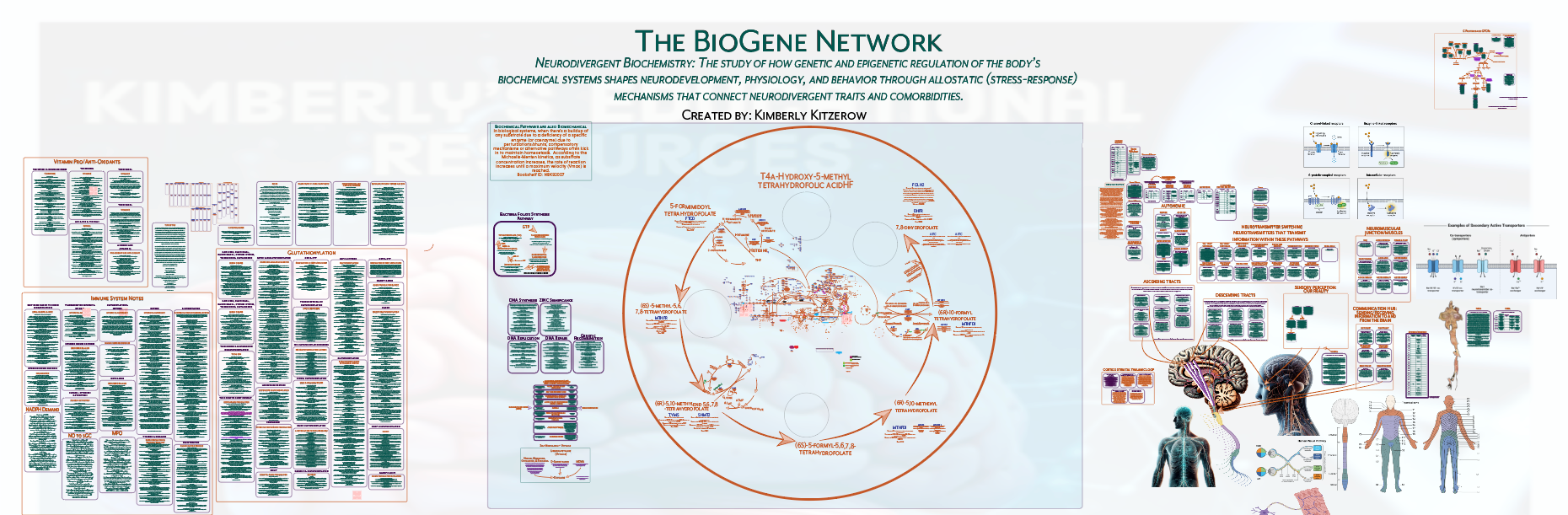
Welcome to the Scientific Method
Kimberly Kitzerow is a teacher by profession, not an academic researcher. This work emerged from a practical effort to solve a real-world problem and was guided by the scientific method throughout.
The goal was not to advance an academic career or challenge research norms, but to follow the most direct and appropriate path dictated by the problem itself. For this reason, the work did not proceed through traditional academic publishing routes.
This work is intentionally shared as open access on ResearchGate to support transparency and constructive dialogue. Because it is not submitted to a journal, it is not eligible for traditional peer review, which is an exclusive publication process in which a journal selects two to three reviewers before deciding whether to publish. Instead, thoughtful, interdisciplinary review and feedback are welcomed openly.
The work is legally published and openly accessible, with clear authorship and dates of record. Standard scholarly practices regarding attribution and citation therefore apply.
Scientific rigor is grounded in method, evidence, and open evaluation. Replication is the gold standard of science. What matters now is this: does it withstand time and scrutiny under replication?
The Scientific Method and Replication
-
The Scientific Method
Step 1: Observation / Eureka Moment - My nonverbal autistic daughter could not blow out a candle on her birthday cake, leading to the realization that autism and the comorbidities, including nonverbality, are physiologically linked rather than independent traits.
Step 2: Research - I synthesized existing autism research and gene coded protein-level biological data to understand how autism traits and comorbidities systematically co-occur across phenotypes.
Step 3: Hypothesis (Exclusivity Principle) - It is biologically implausible for autism traits and comorbid traits to co-occur systematically in each phenotype without a shared biochemical root mechanism. So, I hypothesized that differences in biochemical pathway activity across phenotypes drive both autism traits and predictable comorbidity patterns.
Step 4: Experiment / Testing Methodology - I created a biochemical network of gene-coded proteins and mapped autism-associated biomarkers onto the network.
Step 5: Data Analysis - Identify patterns of convergence across biomarkers and trace the biochemical cascades that plausibly account for the observed associations.
Step 6: Conclusion - Autism arises from gene mutations and epigenetic factors that alter regulatory system behavior and constrain neural development and function. Comorbidities arise when stress-responsive BioToggle activation reallocates proteins via epigenetic, redox-sensitive BH4 shunt trifurcation, producing predictable autism traits via AAAH Shunt induced transamination pathway upregulation resulting in E/I imbalance in the CSTL and dysregulated neural development. While simultaneously resulting in comorbidity clusters shaped by type, timing, and duration of regulatory system activation, with sustained activation increasing cumulative physiological impact via allostatic overload.
Step 7: Communication - I documented and publicly shared the theory, framework, and models to enable scrutiny, replication, and further investigation.
Step 8: Public Education - Created Frameworks and Terminology to explain mechanisms delineated: Neurodivergent Biochemistry, BioToggles, BioDials, etc.
-
Replication
Replication is how the scientific community verifies that those results are real and not a fluke.
A derivative is when someone takes the structure or insight you originated and builds on it, extends it, reframes it, or uses it as a conceptual scaffold for their own work.
Falsification is the process of testing a claim in ways that could prove it wrong so that only ideas that survive those attempts remain standing.
Any core mechanism of this not being present in the biomarkers of autistics would have falsified my model, it’s functions based.
Scientific consensus emerges when many independent replications and lines of evidence converge on the same conclusion.
“Peer review” is a publication process in which you submit to a journal, that journal selects 2-3 people to look it over before they decide to publish. It is not part of the scientific method.
Replications of my Conclusions:
The papers from Stanford, Princeton, Harvard, Brazil, and Japan took the conclusions of my study, turned them into their hypothesis, and then created derivatives that end up confirming the same result.
1. Stanford’s new "cure" targeted the E/I balance within a specific section of the CSTL and it worked.
2.Japan's study had found every single autism gene mutation induced a convergent and consistent stress response.
3. Brazil's study had confirmed a BH4 shunt is present in autism biomarkers (by function).
4.Princeton researchers tested my initial hypothesis, the Exclusivity Principle, directly. They took the core prediction of my framework that autism traits and comorbidities are inseparable because they arise from shared gene-pathway mechanisms, and tested it without citation while presenting it as their own hypothesis.
5. Harvard’s study mapped the anatomical structure of the nervous system BioTogge’s allostatic control system.
*Special Feature: Accidental attempt to replicate my methods and come to a different conclusion by RFK. It was relayed to me that he wanted to “prove” the answer was vaccines. RFK declared he would synthesize autism research to figure out the pathology of autism for nonverbal kids on April 10th. This was 6 days after I got a phone call from DC. They asked how I figured out the pathology of autism. I told them I synthesized autism biomarkers/data, and the story of why I did it for my nonverbal autistic daughter. I documented my reaction to the DC call April 4th in an instagram video that can be found here.
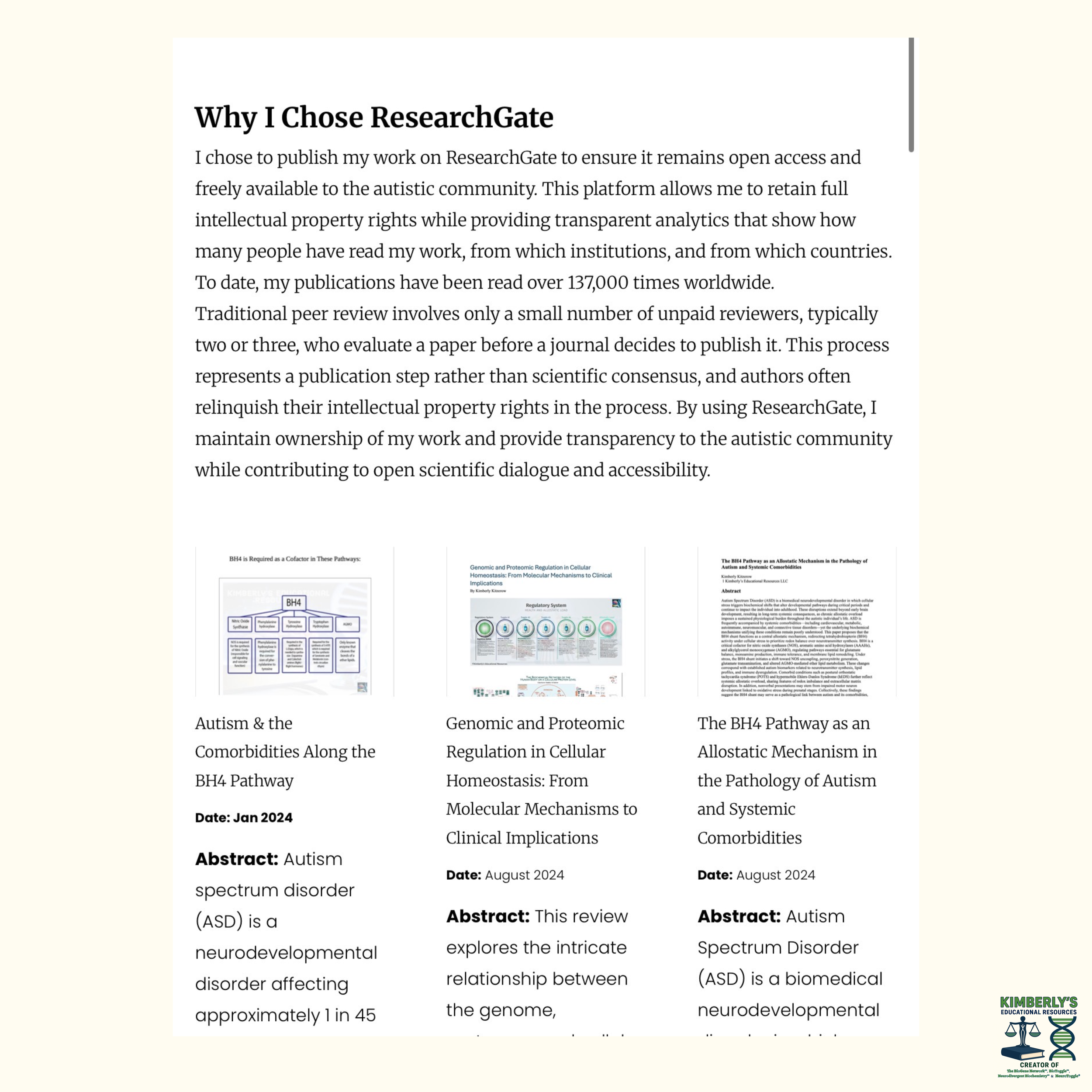
My Methods
Click here for access to the breakdown of my ResearchGate papers with links to each. I also explain why I chose ResearchGate as a platform of dissemination.
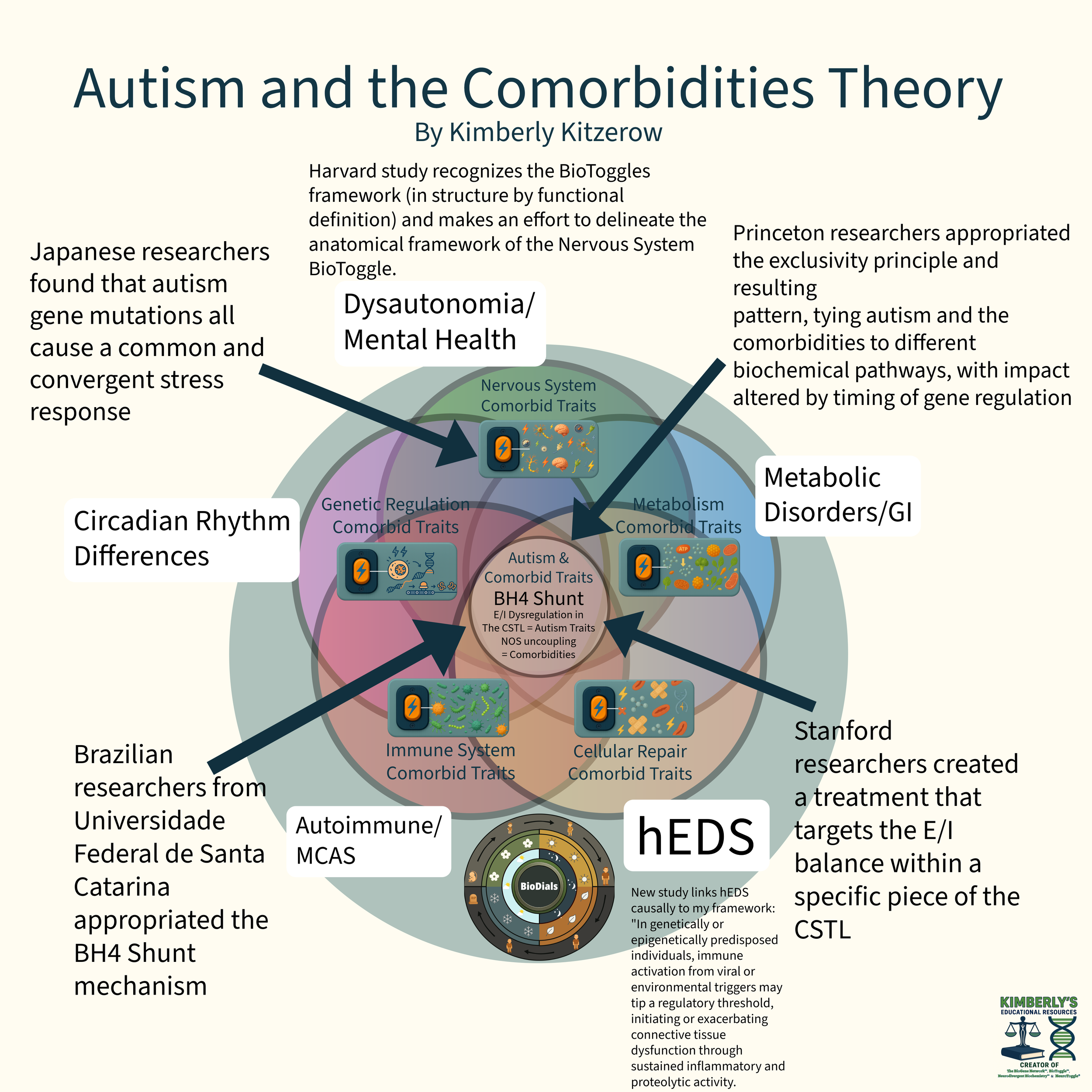
Independent Replications
Click here to learn more about the independent replications of my work. Most recently by several Ivy League institutions. These repiications were uncited.