

Understanding Autism.
Building Skills.
Kitzerow proposes that autism may result when genetic mutations shift resources toward the stress response over typical neural development through the BH4 Shunt, leading her to create NeuroToggle® to support her daughter’s neural development.
Learn the System. Follow the Discovery.
Learn NeuroToggle® or follow the origin of the autism and comorbidities model.

Learn NeuroToggle®
Matching teaching strategies to neural circuit change for skill and behavior development.
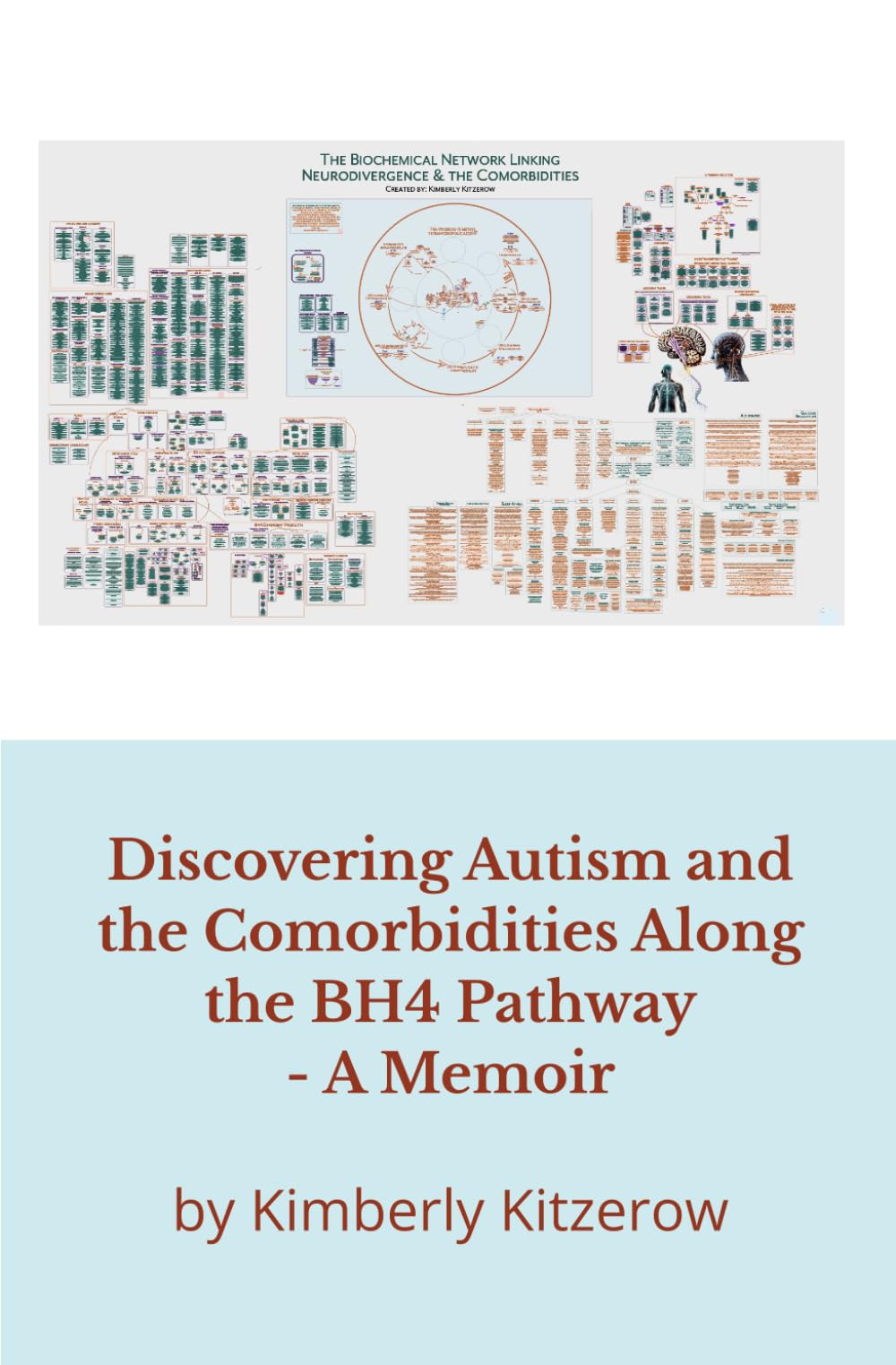
Discovering Autism and the Comorbidities
Read the story of how Kimberly Kitzerow took her nonverbal autistic daughter from silence to speech, and how that journey led to the Autism and the Comorbidities Cascade. Learn about Kitzerow's path from searching for answers to proposing the model. Every purchase helps establish evidence of priority of discovery.
Have Questions?
Start here for the science, educational frameworks, evidence, and practical resources.
I’m a parent. Where do I start?
Start with what your child needs right now. You can read how I helped my daughter, learn what I know about nonverbality, use the plain-language autism guide to understand the bigger picture, and explore NeuroToggle® for building skills and behaviors.
For medical concerns and co-occurring conditions, defer to your child’s qualified medical providers. Biomedical research is still developing. ARIA is currently funding research into genetic medicines, protein interactions, developmental neurobiology, communication, and other therapeutic approaches for autism.
Explore the ARIA Research Roadmap →What is Kitzerow's Autism and the Comorbidities Cascade?
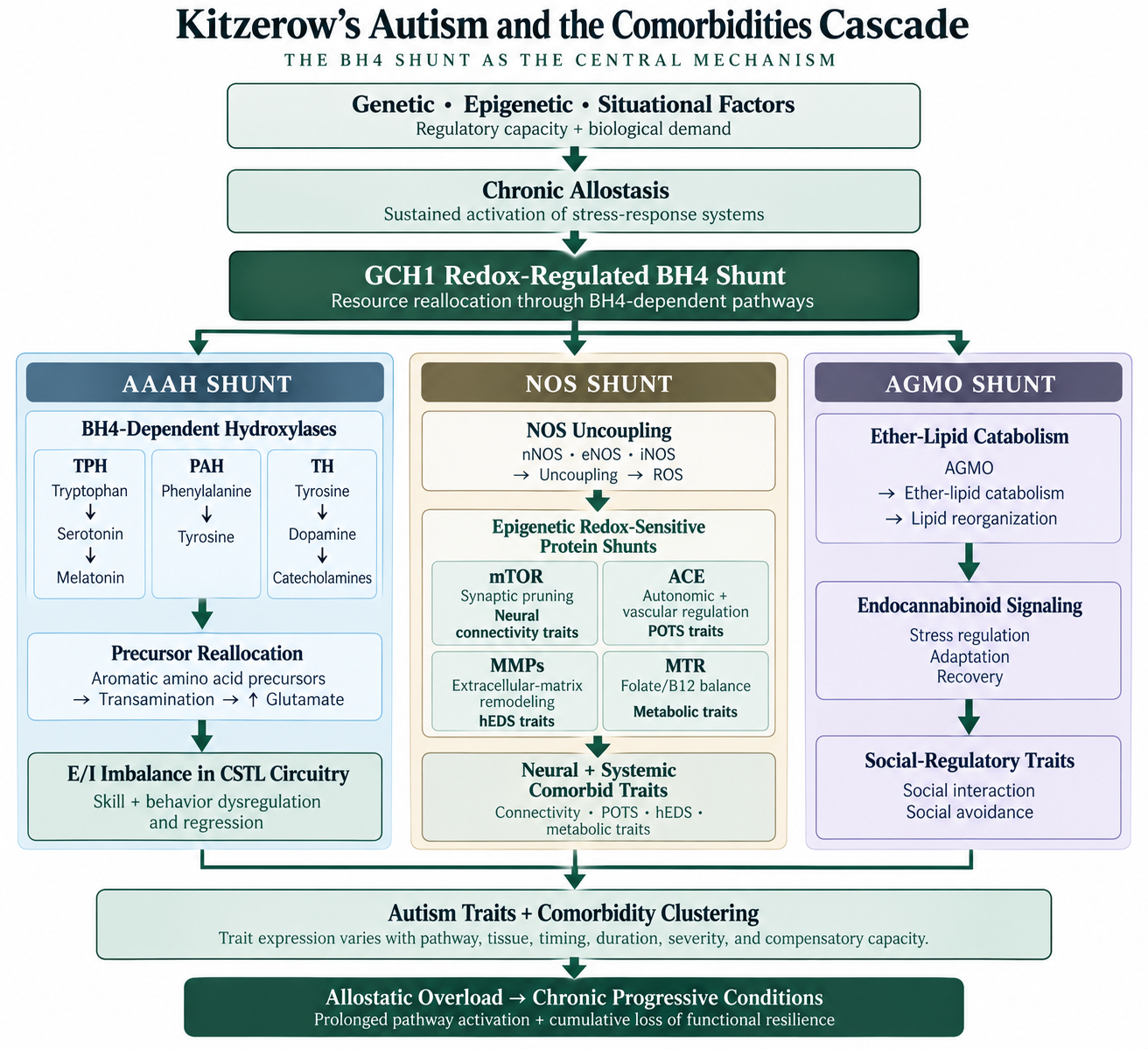
Kitzerow's Autism and the Comorbidities Cascade is a proposed systems-level model that organizes genetic, biochemical, physiological, and neural findings into a connected mechanistic pathway. The model that autism may result when genetic mutations shift biological resources toward the stress response over typical neural development through the BH4 Shunt. The resulting physiological changes affect both the brain and body. In the brain, these changes are proposed to produce the physiological traits expressed through the skills and behaviors used as checklist criteria for an autism diagnosis. Systemically, the same cascade is proposed to produce comorbid traits throughout the body, connecting autism and its patterns of co-occurring conditions within a single systems-level model.
What is NeuroToggle®?
NeuroToggle® is Kitzerow’s educational framework for applying neural plasticity to skill and behavior development. It builds on decades of educational pedagogy and neurodevelopmental resarch by matches teaching strategies to the type of neural change needed: Build, Strengthen, Expand, Time, or Replace.
What is BioToggle®?
BioToggle® is Kitzerow’s framework for physiological plasticity. It builds on decades of existing research by organizing data on biological regulation across interacting systems and over time to explain how the body adapts to changing internal and external demands.
What evidence supports the proposed model?
The model synthesizes and reinterprets decades of existing data rather than simply compiling findings from autism studies. Kitzerow constructed a species-level biochemical reference network from gene-coded human proteins and their established functional relationships, then comparatively mapped autism-associated genetics and biomarkers onto that reference network to identify points of dysregulation at the demographic level. The resulting pattern was used to propose the nodes, directional relationships, and system-level mechanisms of the Autism and the Comorbidities Cascade, which can be evaluated against existing evidence and tested experimentally.
The model has not yet undergone journal peer review because it has not been submitted to a peer-reviewed journal. Kitzerow has published research describing the model and its mechanisms on ResearchGate. She is actively seeking a PhD program and a professor with relevant subject-matter expertise under whom she can further develop and formally test the work. She is specifically seeking a program focused on redox-regulated protein induction across regulatory and temporal systems, including how regulatory-system activation can disrupt redox-regulated temporal processes and the resulting physiological effects. Her options are geographically constrained by a custody agreement with her daughter’s father that prevents her from relocating more than 100 miles, substantially limiting the universities, laboratories, and potential advisors available to her. She is open to collaboration and welcomes independent testing of the model with appropriate citation and attribution.
Convergent evidence is central to evaluating a theoretical model because independent findings can test whether its proposed nodes and relationships occur as predicted. Kitzerow’s Autism and the Comorbidities Cascade synthesizes and reinterprets decades of existing findings into a proposed mechanistic network, while research published after the model was developed provides additional tests of its proposed relationships. This includes predictive nodes such as the proposed BH4 dependent NOS/redox-sensitive protein/mTOR pathway. In 2026, researchers independently identified an NO–TSC2–mTOR mechanism in autism models, finding that nNOS-derived nitric oxide increased TSC2 S-nitrosylation and degradation, resulting in mTOR dysregulation and downstream synaptic effects. As additional research is published, each proposed node and relationship can be supported, refined, or falsified. So far, every node that has been tested has been supported, and the model remains unfalsified, not because of a lack of testing, but because evidence continues to converge with its predictions.
Kimberly Kitzerow
Kimberly Kitzerow is an educator specializing in data synthesis, author, and neurodivergent advocate.
Her work began while searching for answers and practical ways to support her nonverbal autistic daughter.
Questions, Collaboration, or Speaking Inquiries
Contact Kimberly about educational resources, research collaboration, interviews, speaking, or questions about the work.