

Recent Tests of Kitzerow’s Autism and the Comorbidities Cascade
Since 2025, the mechanisms the Cascade proposes have been tested, intentionally or unintentionally, in independent studies. Each study below is mapped to the relationships it tests or informs, alongside earlier foundational evidence.
Kitzerow connected previously fragmented findings into one biochemical cascade. If the model is accurate, independent evidence should increasingly support its specific predictions.
- 12independent studies and frameworks mapped onto the Cascade
- Each studyshows the relationships it tests, the kind of evidence, and what remains untested
- StatusAn emerging theoretical model, with evidence converging around its accuracy
Three steps
- Start with the combined mapAll study highlights appear together first.
- Choose a studySelect a tab to isolate that study’s connections on the diagram.
- Match the numbersEach numbered marker matches a short step beside the diagram; the explanation follows below.
What the highlights mean: they map findings or proposed relationships onto the Cascade. They do not mean the authors tested the whole model or set out to test it. Experiments, genetic analyses, reviews and proposed frameworks answer different questions, so each result box names the kind of evidence and what remains untested.
New to the terminology?
- Comorbidities
- Other conditions that occur alongside autism.
- BH4
- Tetrahydrobiopterin, a molecule that several enzymes need to function, including enzymes involved in neurotransmitters and nitric oxide.
- Redox
- Chemical processes involving oxidation and reduction. They help regulate cells; an imbalance can cause oxidative stress.
- Allostasis
- The body’s adjustment to demands. The Cascade uses chronic allostasis for sustained activation of stress-response systems.
- E/I balance
- The relationship between signals that promote and restrain neural activity. It depends on the specific cells and circuits involved.
- CSTL
- Cortico-striatal-thalamo-limbic circuitry: interacting brain systems involved in functions such as movement, habits, sensory processing, and emotion.
- mTOR
- A signaling system that helps regulate cellular growth, metabolism, and protein production.
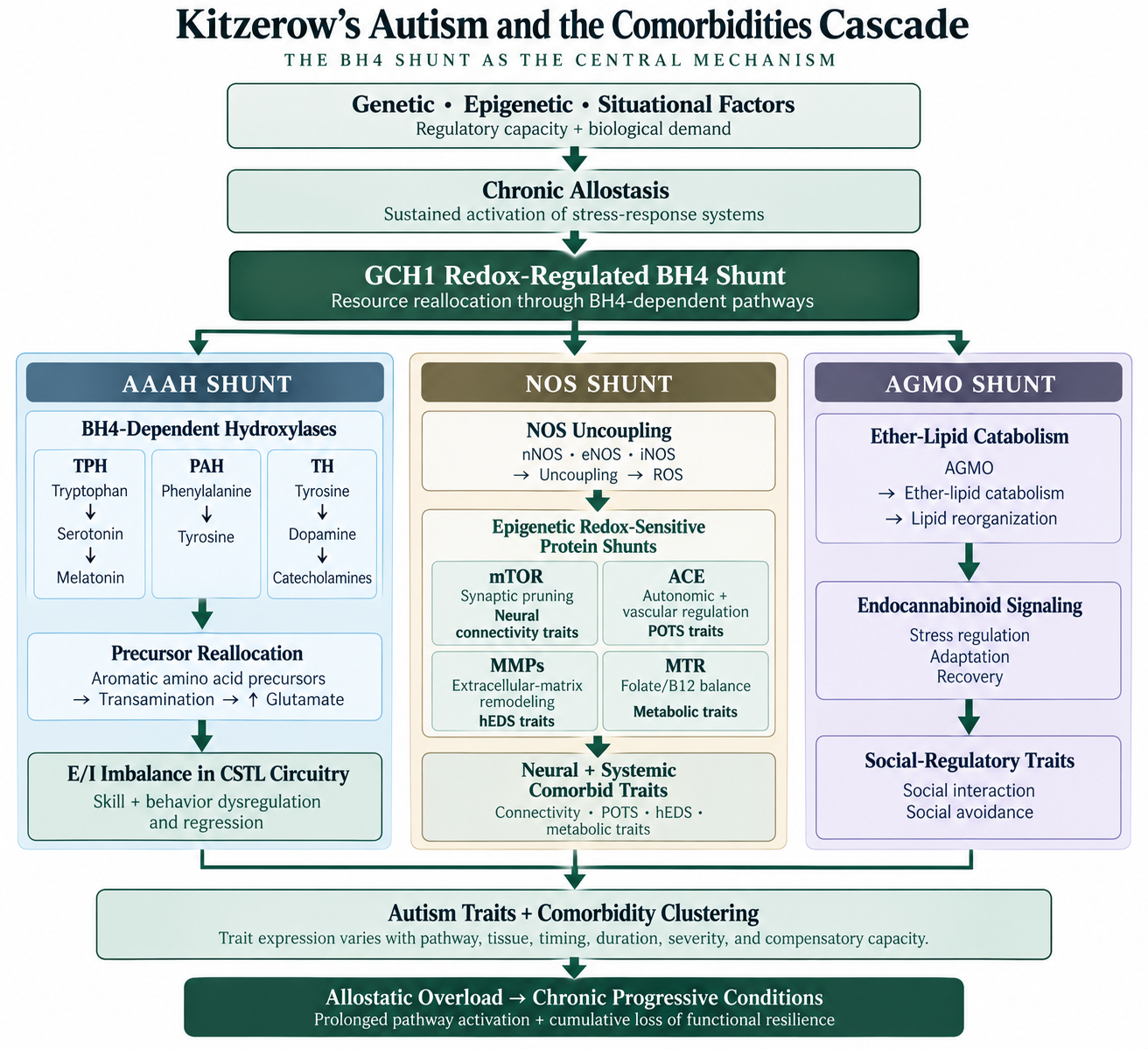
The Cascade is still being researched, and its validation depends on continued testing and convergent evidence.