


Welcome to Kimberly’s Educational Resources!
“Understanding Neurodivergence and Comorbidities Through Biochemistry”
Search Bar:
From Silence to Speech
Kimberly Kitzerow is a mother, educator, and systems analyst who, in her determination to help her nonverbal autistic daughter speak, created a novel framework for understanding how stress-regulated redox biology shapes learning, development, and function.
- Autism Traits: NeuroToggle® for skill and behavior development
- Comorbid Traits: Neurodivergent Biochemistry for understanding how stress alters development and function over time
- Educational frameworks and instructional strategies
- Systems-level models of neurodevelopment and physiology
- Resources for educators, therapists, and parents
From one child’s progress to five frameworks
Watch how this work developed from real-world application into NeuroToggle® and Neurodivergent Biochemistry.
The Breakthrough That Started It
What began as Kimberly Kitzerow's effort to help her daughter speak led to the development of NeuroToggle® and the broader frameworks that followed.
-
2020 - The Problem
Kimberly’s daughter was nonverbal and unable to coordinate the motor patterns required for speech.
-
2020 - The Shift
When she could not blow out the candles on her fourth birthday cake, it revealed that the neural circuits required for coordinated speech were not functioning as intended.
-
2021 - Building NeuroToggle®
Neuroplasticity was applied to build, strengthen, time, and expand those circuits into communication. This is the foundation of NeuroToggle®.
-
2022 - The Results
Her daughter became conversational, and she began sharing their story online in the hopes of helping more children.
-
2023 – Theoretical Model
Developed the Autism and Comorbidities Model, formed Kimberly’s Educational Resources LLC, and began writing.
-
2024 – Framework Expansion
Developed Neurodivergent Biochemistry and documented the work through resources, websites, videos, and ResearchGate articles.
-
2024 – Education + Funding
Crowdfunded for Bioinformatics at UW–Madison, earned all A’s, requested support, and was told a PhD was required before assistance.
-
2025–2026 – Validation
Within months, independent research aligned with and validated the core pillars of this model at the mechanistic level.
Educational Framework and Research Framework
Autism traits and comorbid traits arise from the same underlying processes, but affect different systems in the body. Because of that, they do not respond to the same type of support.
Educational Consulting
NeuroToggle®
- The information for how to “do” skills and behaviors is encoded in neural circuits.
- Neurodevelopmental conditions impact how those circuits form, which impacts skill and behavior development.
- Neuroplasticity targets how those circuits are built and refined.
- NeuroToggle® uses established teaching pedagogy to optimize the building, strengthening, timing, and expansion of neural circuits.
Research and Advocacy
Neurodivergent Biochemistry
- Neurodivergent Biochemistry studies how different categories and durations of stress activation alter development and function over time.
- BioToggles define the categories of stress activation.
- BioDials define the typical development and function cycles that are disrupted.
- Kitzerow’s Autism and the Comorbidities Theoretical Model defines long-term developmental and functional outcomes.
Choose the path most relevant to you
Explore the core frameworks, parent resources, research materials, and educational tools that organize this work.
For Parents
This path helps parents separate autism traits from comorbid traits so support can be matched to the right problem. It explains how skills and behaviors are supported through neural circuits and neuroplasticity, how body-based comorbid traits relate to regulatory systems, and where to start with nonverbal autism, communication, and advocacy.
For Researchers
This path provides access to the research papers, timeline, primary sources, methodology, framework structure, validation, and credentials needed to evaluate the model. It is organized to support review of the framework’s construction, biological structure, and comparison to independent findings.
For Educators
This path explains how learning, memory, skills, and behavior are encoded in neural circuits, how neurodevelopmental differences alter that process, and how instruction can be aligned to those differences to build and strengthen skills through neuroplasticity using the NeuroToggle framework.
For Neurodivergent Individuals
This path explains the pathology of autism and comorbid traits, including the biological mechanisms that cause them to cluster. It uses the five core frameworks to map how regulatory systems, biochemical pathways, and developmental timing interact across the body and brain.
The 4 Testable Pillars of Kitzerow’s Autism and the Comorbidities Theoretical Model
These four pillars explain how biological stress responses shape development, function, autism traits, and comorbid conditions across systems.
This provides a structured way to understand how these traits are biologically connected.
Stress Activation
Genetic and epigenetic factors activate internal stress-response systems across regulatory domains, including the immune system, metabolism, cellular repair, nervous system, and genetic regulation.
BH4 Pathway Shunt
Stress-response activation redirects biochemical pathway activity through the BH4 Shunt, reallocating biochemical resources and shifting activity across interconnected pathways.
Neural Circuit Disruption
These pathway shifts alter neurotransmitter balance and disrupt neural circuitry involved in communication, behavior, and regulation, driving the expression of autism traits.
Comorbidity Clustering
Downstream effects of epigenetic redox-sensitive protein shunts disrupt function across systems, causing autism traits and comorbid conditions to cluster together over time.
Kimberly Kitzerow's daughter was nonverbal. Helping her speak led to five documented frameworks.
What began as one question about why Kimberly’s daughter could not physically speak expanded into five frameworks connecting autism traits, comorbid traits, and the biological mechanisms that cause them to cluster.
Kimberly’s daughter was nonverbal. She is now fully conversational.
The search for why that happened moved beyond behavior and into mechanism. From there, the work expanded into five original frameworks.
Observation
While trying to understand her daughter’s nonverbal autism, Kimberly Kitzerow built a biochemical network of human gene coded proteins and compared autism biomarkers to it to identify points of dysregulation.
Discovery
That comparison revealed biological shifts connecting autism traits with commonly occurring health conditions. This became Autism and the Comorbidities Theory.
Five Frameworks
As the work deepened, it expanded into five connected frameworks: NeuroToggle, Neurodivergent Biochemistry, BioToggle, BioDial, and Autism and the Comorbidities Theory.
Why It Matters
Later institutional publications echoed many of the same mechanisms years after her public documentation, raising questions of convergence, prediction, and attribution.
The Timeline Behind the Five Frameworks
The key turning points, from understanding nonverbality as a physiological comorbidity to building a broader model of why autism and comorbid traits cluster.
2020
Nonverbality identified as physiological
Kimberly recognized that nonverbality was a physiological autism comorbidity rather than a behavioral or cognitive symptom when her daughter could not physically blow out birthday candles.
2020–2022
NeuroToggle is built
The first framework focused on how neural circuits can be built, strengthened, expanded, and timed to support skill and behavior development, including speech.
2022
The broader question emerges
The focus expanded from speech alone into a larger question: why do autism traits and comorbid conditions cluster the way they do?
2022–2023
Biochemical network is built
Gene coded protein mapping identified points of dysregulation connecting autism traits with commonly co-occurring conditions.
2023–2024
Five frameworks are formalized
NeuroToggle, Neurodivergent Biochemistry, BioToggle, BioDial, and Autism and the Comorbidities Theory take formal shape.
2025–2026
Convergence appears in later research
Later publications align with many of the same mechanisms, raising larger questions about prediction, convergence, and attribution.
NeuroToggle® Books
Neurodivergent brains aren’t just diverse. They operate under different biological states.
Stop managing behavior.
Start building the circuitry behind it.
These books introduce a different way to understand behavior and skill development by focusing on the neural circuitry that produces them.

Book 1
Reframes education through neuroplasticity and explains why behavior-only approaches are limited.
Start with Book 1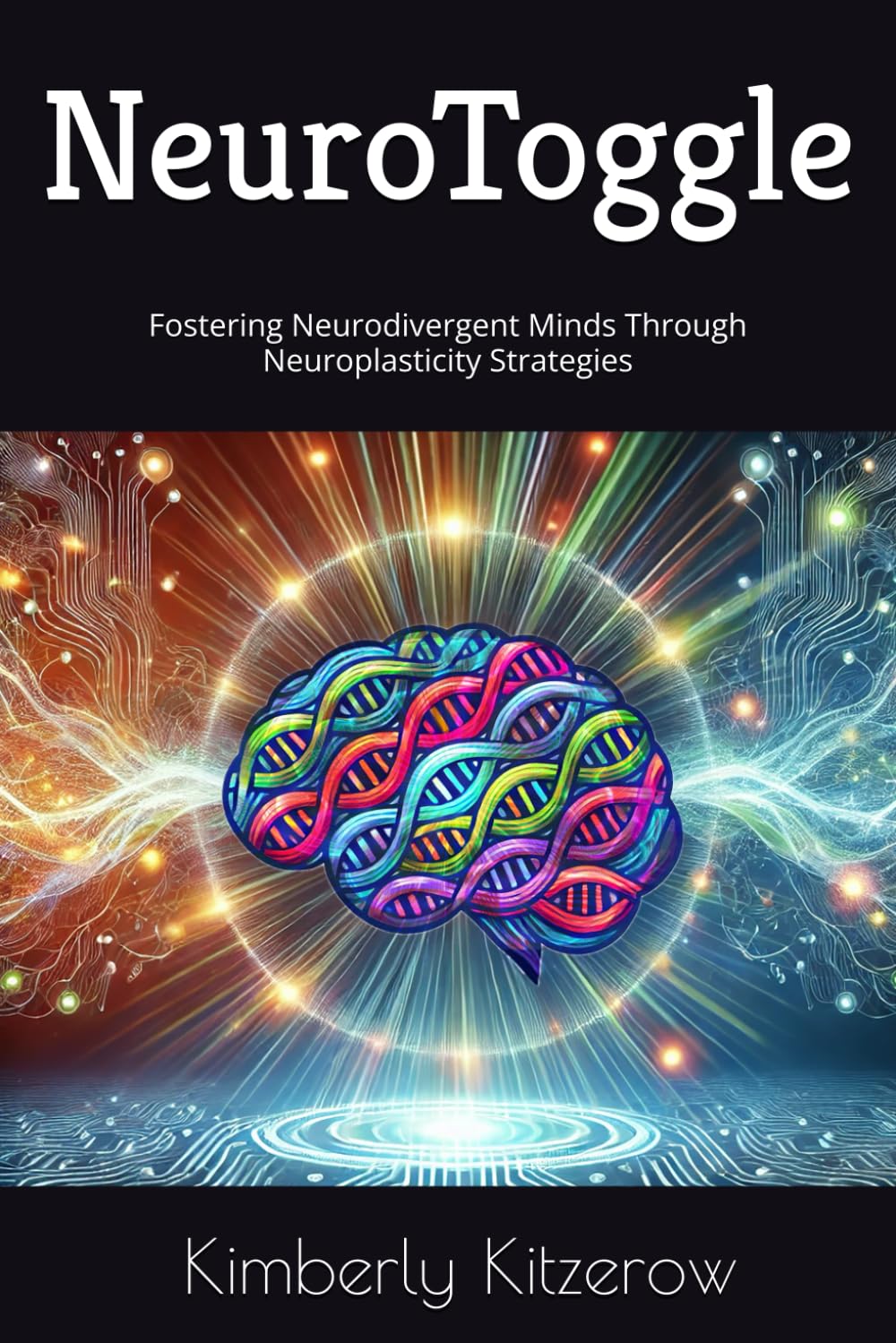
Book 2
Formalizes NeuroToggle® into a neuroscience-based instructional framework built around building, strengthening, timing, and expanding neural connections.
Continue with Book 2Resources To Learn More
Books
Memoirs documenting Kimberly Kitzerow’s journey helping her daughter transition from nonverbal autism to speech and books outlining the NeuroToggle instructional framework.
Utilization
Utilization of Kitzerow’s utism and the Comorbidities Theory in recent research including studies examining BH4 pathway dysfunction in autism and biochemical mechanisms linking autism traits with comorbidities.
Researchgate Papers
Research papers that document the development of Neurodivergent Biochemistry and supporting scientific literature connected to the BH4 pathway, BioToggles, BioDials, and the Autism and the Comorbidities theory.
Etsy Store
Infographics, and educational materials designed to help families and educators understand neurodivergent development and the biological concepts connected to autism and its comorbidities.

Take Action Now
There are three simple ways to support
Sign the petitions here to increase awareness and encourage institutional review.
Send an email to any educator, researcher, clinician, legislator, or organization you want to inform.
Share this information on social media so more people learn about these frameworks.
Contact us with comments to post on our website!
Get in Touch
Kimberly is active on social media and responds to many comments. For professional, educational, licensing, or research inquiries, use the contact form. She does not check direct messages.
To support Kimberly's independent research, advocate for her work, or access the full primary source list and integrity policy, see the link below.