


Welcome to Kimberly’s Educational Resources!
Search Bar:
Understanding Neurodivergence Through the Science of Biochemistry.
“We must regulate before we educate.”
Original models by Kimberly Kitzerow — synthesizing biochemistry, neurology, and developmental science into practical frameworks for educators, clinicians, and families.
A documented origin story
Kimberly Kitzerow's daughter was nonverbal. Helping her speak led to the building of five frameworks.
What began as one question about the mechanism behind why Kimberly's daughter couldn't physically speak led to the development of five documented frameworks connecting autism traits, comorbid traits, and the biochemical regulatory mechanisms that result in them clustering into phenotypes.
The starting point
Kimberly’s daughter was nonverbal. She is now fully conversational.
The search for why that happened led beyond behavior and into mechanism, and from there into five original frameworks.
-
Observation
While trying to understand her daughter’s nonverbal autism, Kimberly Kitzerow created a biochemical network of human gene coded proteins and compared autism biomarkers to it to identify points of dysregulation.
-
Discovery
What she found was a series of biological shifts that connect autism traits and commonly occurring health conditions. This became Autism and the Comorbidities Theory.
-
Five Frameworks
As the work deepened, it expanded into five connected frameworks: NeuroToggle, Neurodivergent Biochemistry, BioToggle, BioDial, and Autism and the Comorbidities Theory.
-
Why It Matters
Her conclusions were later echoed in institutional publications released years after her public documentation, raising the question of whether the model was predictive or used without attribution.
NeuroToggle® Books
Neurodivergent brains aren’t just diverse. They operate under different biological states.
Stop managing behavior.
Start building the circuitry behind it.
These books introduce a different way to understand behavior and skill development by focusing on the neural circuitry that produces them.

Book 1
Reframes education through neuroplasticity and explains why behavior-only approaches are limited.
Start with Book 1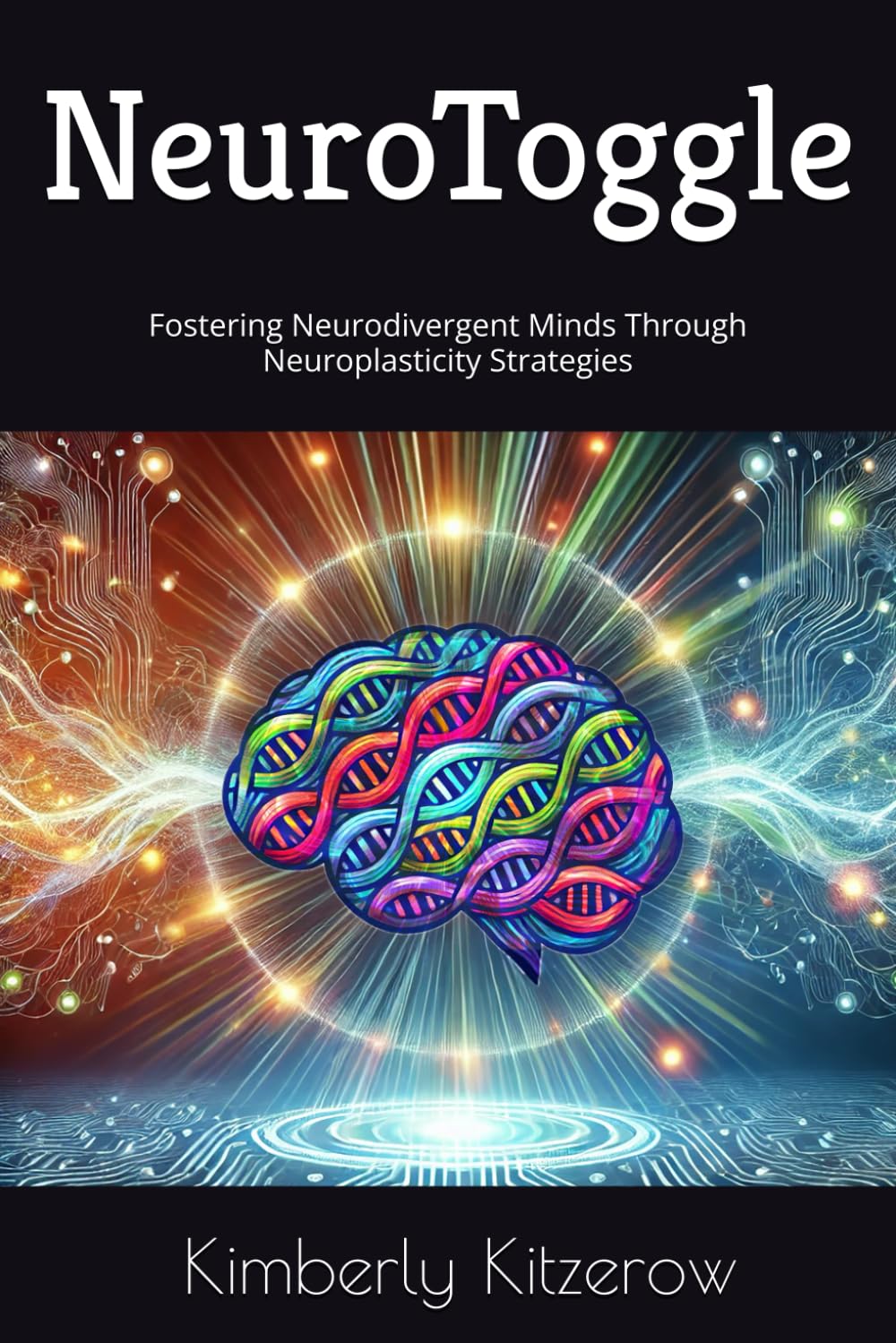
Book 2
Formalizes NeuroToggle® into a neuroscience-based instructional framework built around building, strengthening, timing, and expanding neural connections.
Continue with Book 2Original frameworks built from the ground up
Each novel framework emerged from raw protein data-level synthesis via biochemical network construction utilizing data from Uniprot— not from summarizing existing literature, but from organizing raw biological findings into coherent, novel models.
Novelty of NeuroToggle
The first physiologically informed instructional framework that builds the neural circuitry that produces skills and behaviors rather than attempting to modify the behaviors or skills themselves.
Novelty of Kitzerow’s Autism & the Comorbidities Theory
The first causal theoretical model to organize all causes of autism around regulatory system domain activation linked to a joint biochemical cascade with each node explaining an autism trait, comorbid trait, or clustering mechanism.
Novelty of Neurodivergent Biochemistry
The first framework to organize how different types and durations of biochemically induced stress alter temporally regulated processes of development and function across the lifespan.
Novelty of BioToggle® and the BioDials
The first classification systems to categorize epigenetically regulated protein synthesis into categorical regulatory system domains and temporal cycle domains, mapping how each drives protein induction.
Scope and Classification of Each of Kitzerow’s Frameworks
This work spans multiple frameworks. The following clarifies the scope and evidentiary classification of each.
Brief Overview of Scope and Classification:
NeuroToggle® is population wide because skill development occurs through neural connectivity encouraged by teaching pedagogy across all humans.
The application of NeuroToggle® to target the skill of speech development is n = 1 until broader studies are conducted.
Gene coded protein function is conserved across humans, making the classification of Kitzerow’s BioGene biochemical network population wide.
Autism biomarker data is demographic wide, and comparing it to Kitzerow’s BioGene biochemical network shows how the autism demographic differs from population wide biochemical activity.
-
NeuroToggle® describes the science of skill and behavior development through neural connectivity. Learning occurs as neural circuits are built, strengthened, expanded, and timed through instruction. These mechanisms are grounded in human neurobiology and apply broadly across the population because all humans develop skills through neural connectivity and neuroplasticity.
-
Using NeuroToggle® to target the specific skill of speech with my daughter when she was nonverbal represents an individual application of the framework. The framework itself is population wide, grounded in how all humans build skills through neural connectivity. My daughter went from nonverbal to fully conversational, but this outcome is anecdotal and classified as n = 1 until broader pilot testing or structured studies are conducted. What is generalizable is the framework. What remains anecdotal is this specific application.
-
The biochemical network was built using gene coded protein data. Because these proteins and their pathway functions are highly conserved (99.9%) across humans, this dataset represents population level human biology rather than individual observations. Variability is in efficacy, not in which ones are produced. This biochemical network was organized by gene coded protein function, with efficacy impacting health.
-
The autism theoretical model emerges by comparing autism biomarker data from the autism demographic with the population wide biochemical network. This comparison identifies where regulatory systems within the autism demographic diverge from population biology. Because the network was organized by protein function rather than gene variants, genomic variability does not affect the outcome. Variants influence efficacy within pathways, not which functions or pathways exist. The network remains a stable population wide reference point regardless of individual genomic differences.
-
BioToggles describe the patterns of regulatory system mediated protein synthesis identified within the biochemical network. Because they are derived from gene coded protein data and conserved biological pathways, BioToggles represent population level biology rather than individual observations.
-
BioDials describe the patterns of temporally regulated protein synthesis identified within the biochemical network. Because they are derived from gene coded protein data and conserved biological pathways, BioDials represent population level biology rather than individual observations.
Resources To Learn More
Books
Memoirs documenting Kimberly Kitzerow’s journey helping her daughter transition from nonverbal autism to speech and books outlining the NeuroToggle instructional framework.
Utilization
Utilization of Kitzerow’s utism and the Comorbidities Theory in recent research including studies examining BH4 pathway dysfunction in autism and biochemical mechanisms linking autism traits with comorbidities.
Researchgate Papers
Research papers that document the development of Neurodivergent Biochemistry and supporting scientific literature connected to the BH4 pathway, BioToggles, BioDials, and the Autism and the Comorbidities theory.
Etsy Store
Infographics, and educational materials designed to help families and educators understand neurodivergent development and the biological concepts connected to autism and its comorbidities.
Resources for Parents of Nonverbal Kids
Nonverbality is an autism comorbidity. This is the comorbidity that Kitzerow’s daughter had that sent her looking for the link between autism and the comorbidities, which sparked the creation of all of this!
Parents of Nonverbal Children Start HERE.
From Silence to Speech
Learn how I helped my nonverbal autistic daughter develop speech by identifying the physiological mechanisms behind communication and building structured neuroplasticity-based strategies.
Folinic Acid Concerns
Overview of concerns of giving megadoses of folinic acid to growing children given its role in cell turnover. As well as concerns about a folinic acid study that was put on a full clinical hold by the FDA.
Letters to State and Federal Representatives
Read my communications with policymakers addressing the need for reform in autism research, education, and diagnostic criteria, along with specific legislative recommendations.
Understanding Nonverbality Through Speech-Motor Pathways
Overview of the specific mechanisms that connect the brain to the physical production of speech.

Take Action Now
There are three simple ways to support
Sign the petitions here to increase awareness and encourage institutional review.
Send an email to any educator, researcher, clinician, legislator, or organization you want to inform.
Share this information on social media so more people learn about these frameworks.
Contact us with comments to post on our website!
Get in Touch
Kimberly is active on social media and responds to many comments. For professional, educational, licensing, or research inquiries, use the contact form. She does not check direct messages.
To support Kimberly's independent research, advocate for her work, or access the full primary source list and integrity policy, see the link below.